If you want to know how to launch a coin on Base, the good news is that it is one of the cheapest places to do it. A real launch there this month paid about three cents in gas. The harder question is where to launch, because Base has several well-known launchpads, and they pay creators in very different ways.
This guide does both. First the five steps to launch a coin on Base with Runitup, using real screenshots of the form. Then an honest table comparing Runitup with Zora, Clanker and Flaunch, with every rival figure taken from their own docs on 27 October 2026.
Runitup is our product, so read the comparison with that in mind. Where a rival pays creators more, or has a bigger audience, we say so.
What Base is, and why a coin on Base is cheap
Base is a layer 2 network built by Coinbase. It runs on top of Ethereum: transactions happen on Base, and batches of them are posted to Ethereum for security. For you, that means two things.
First, gas is paid in ETH, the same ETH you use on Ethereum, just on a different network. Your wallet treats Base as its own network, chain ID 8453, so ETH on Ethereum mainnet has to be bridged to Base before you can use it there.
Second, it is cheap. The base fee on Base was 0.005 gwei when we checked on 27 October, against about 0.116 gwei on Ethereum mainnet. A gwei is a billionth of an ETH, the unit gas prices are quoted in.
Base is also where a lot of memecoin activity already lives, which is why Zora's coins, Clanker and Flaunch all run there. A coin on Base launches into a crowded, busy market. That cuts both ways.
How much it costs to launch a coin on Base
On Runitup the cost has three parts, and one of them is optional.
| What you pay | Amount on Base | Notes |
|---|---|---|
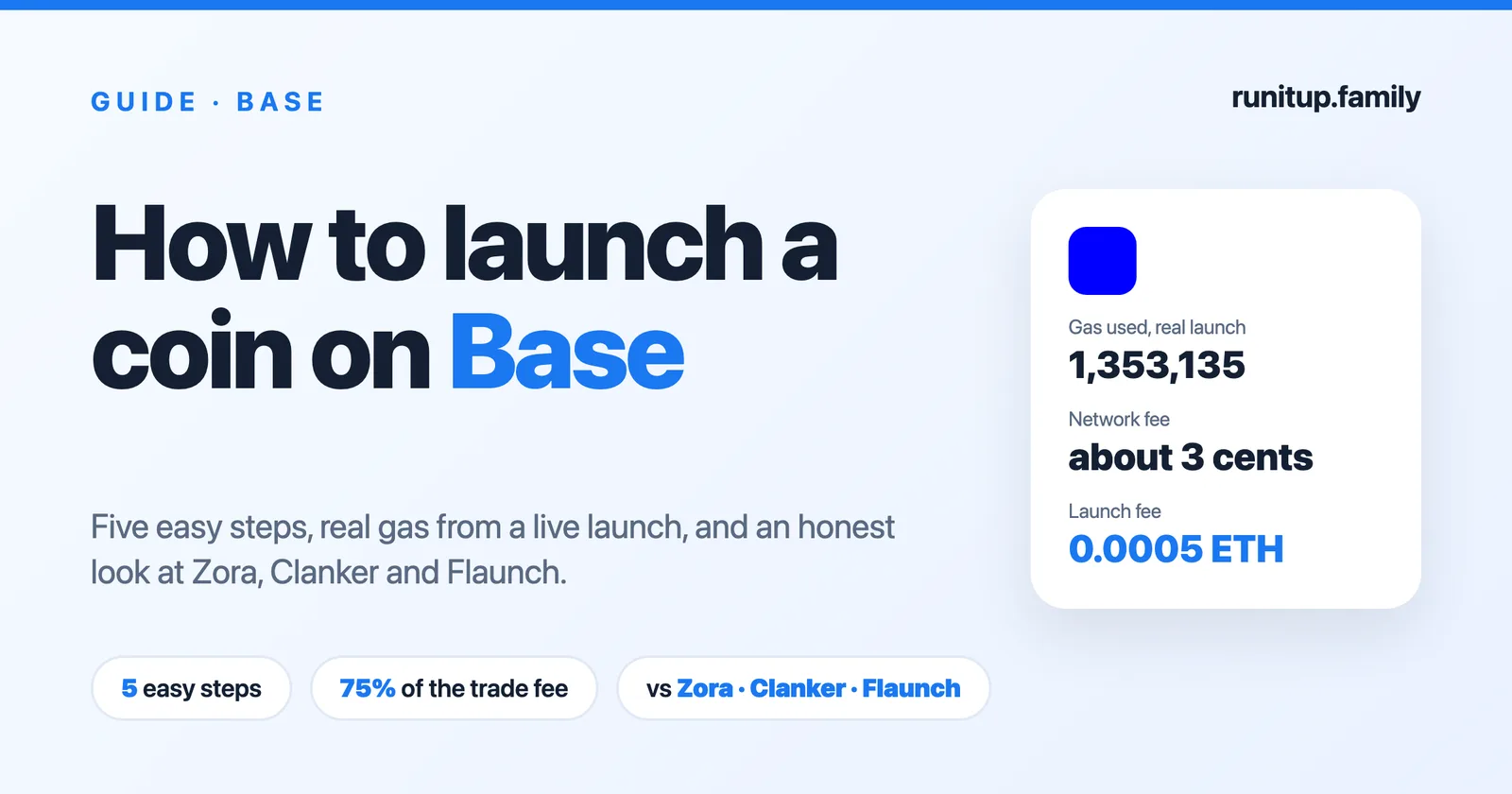
| Launch fee | 0.0005 ETH | About $1.17 at ETH $2,340 |
| Network fee (gas) | about 0.00001 ETH | A few cents |
| Liquidity you must supply | None | The pool opens one-sided |
| Dev buy | Optional | Your choice, can be zero |
Here is a real one. On 23 October 2026 a launch went through the Runitup factory on Base (0xE17Ee593188F393B4e6ec0e6F6ADfD2CfF6184Db) in transaction 0xbd3f7caf…eb3d. It used 1,353,135 gas at about 0.01 gwei. The whole network fee, including the small charge for posting data to Ethereum, was 0.0000136 ETH. That is about three cents. It sent exactly 0.0005 ETH, the launch fee, with no dev buy.
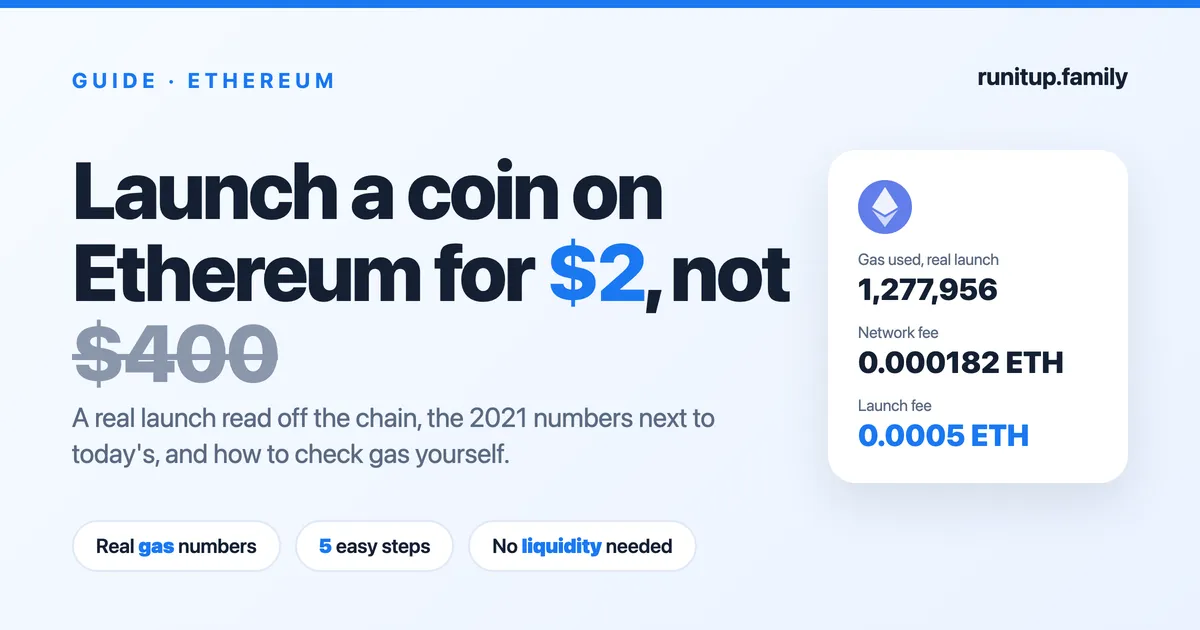
So a coin on Base costs about $1.20 all in, before any dev buy. For comparison, the same kind of launch on Ethereum mainnet costs roughly $1.50 to $2 on a quiet day. We read real Ethereum launches in our guide to the cost of a coin on Ethereum.
Why there is no liquidity to supply
This is the line people do not believe. When you launch a coin on Base with Runitup, your pool opens holding 100% of your token supply and zero ETH. The position's lower edge sits at the opening price, so below that price it holds no ETH and does not need any. ETH only enters the pool as people buy. The single-sided pool docs explain the mechanics.
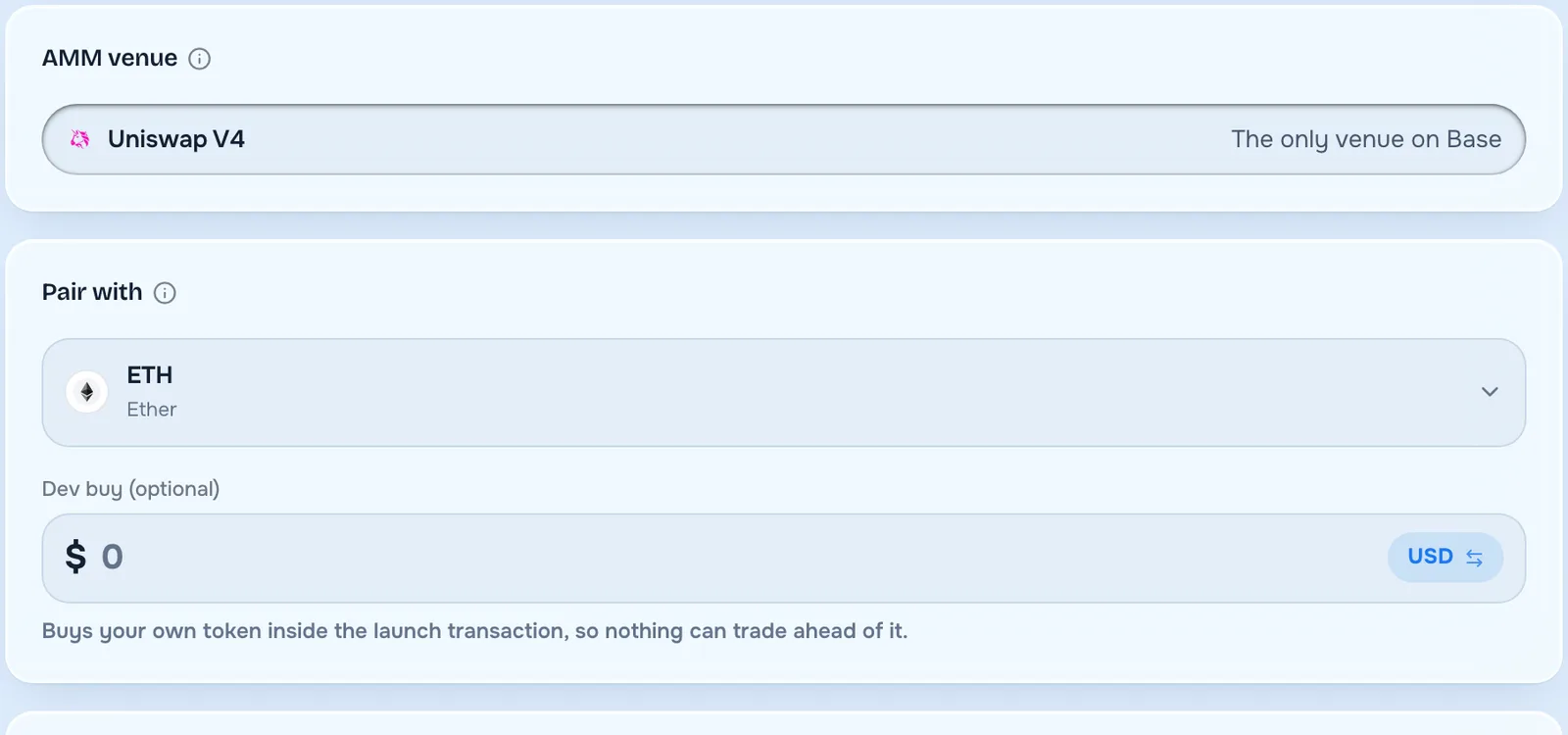
For an ETH pair the starting market cap is 1.5 ETH, which the form showed as $3.51K on 27 October. That is where your first buyer starts.
How to launch a coin on Base in 5 steps
The whole thing takes a few minutes. You need a wallet, a little ETH on Base, and a name for your coin.
1. Get a little ETH onto Base
To launch a coin on Base you need 0.0005 ETH for the launch fee and a few cents of gas, so 0.001 ETH is plenty. Add more if you want a dev buy.
The ETH has to be on Base, not on Ethereum mainnet or another network. If your ETH is elsewhere, bridge it first, or withdraw from an exchange that supports Base withdrawals. Your wallet shows which network you are on.
2. Open the launch page and tap Base
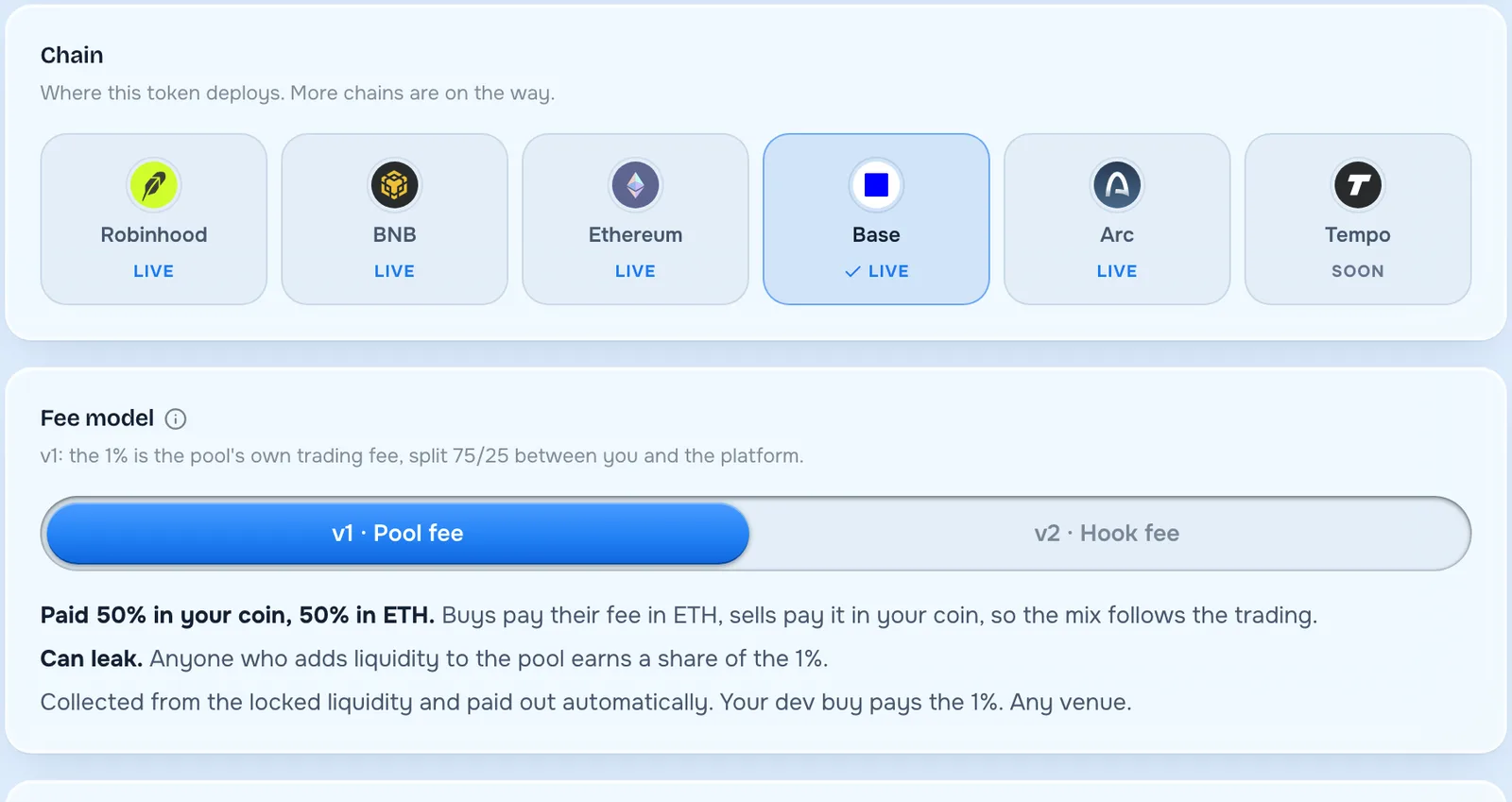
Go to the Runitup launch page and pick Base under Chain. Runitup is live on five chains, so check the tick lands on Base before you go further.
Leave the launch type on Quick unless you want a taxed token. Quick is a plain token: one 1% trade fee and nothing taken on transfers. Advanced launches, with a tax you set, are also open on Base.
3. Fill in name, ticker and image
To launch a coin on Base you only need four things: a name, a ticker, a total supply (pre-filled) and a fee recipient (pre-filled with your wallet). The image, description and social links are optional and can be edited later.
The name and ticker are permanent. Read them twice before you sign.
4. Pick the fee model and an optional dev buy
On Base the form offers two fee models. Traders pay 1% either way.
- v1, pool fee. The 1% is the pool's own fee, split 75/25 between you and the platform. Buys pay their fee in ETH and sells pay it in your coin, so you earn some of each.
- v2, hook fee. A Uniswap V4 hook charges the 1% on a pool with no LP fee: 0.75% to you, 0.25% to the platform, and every fee arrives in ETH. It also lets you add a sniper window, where bots buying in the first seconds pay a much higher fee and 75% of it goes to you.
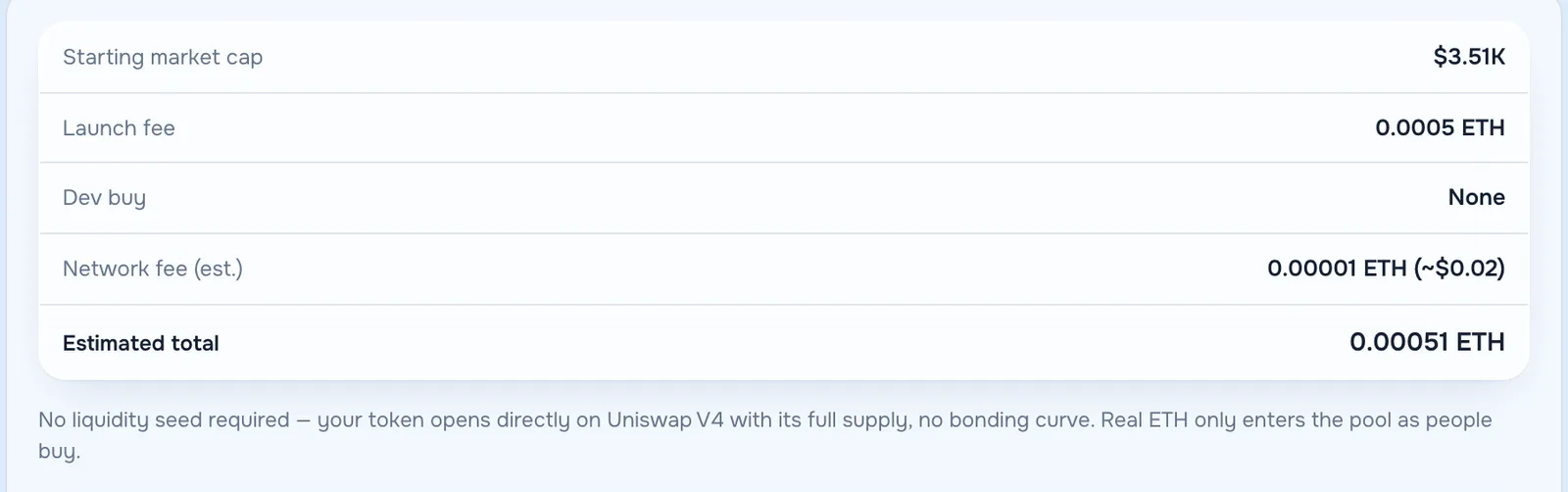
Uniswap V4 is the only venue on Base, and the form pairs your coin with ETH.
A dev buy is optional. It buys some of your own coin inside the launch transaction, so nobody can trade ahead of you. It shows publicly as "Creator holds" on your token page.
5. Check the cost panel and confirm
The panel above the button shows the starting market cap, the launch fee, your dev buy, a network fee estimate and the total. On 27 October it showed a network fee of 0.00001 ETH (about $0.02) and a total of 0.00051 ETH with no dev buy.
Sign, and your coin on Base is trading on a real Uniswap V4 pool the moment the transaction confirms. There is no bonding curve and nothing to graduate.
Runitup vs Zora, Clanker and Flaunch on Base
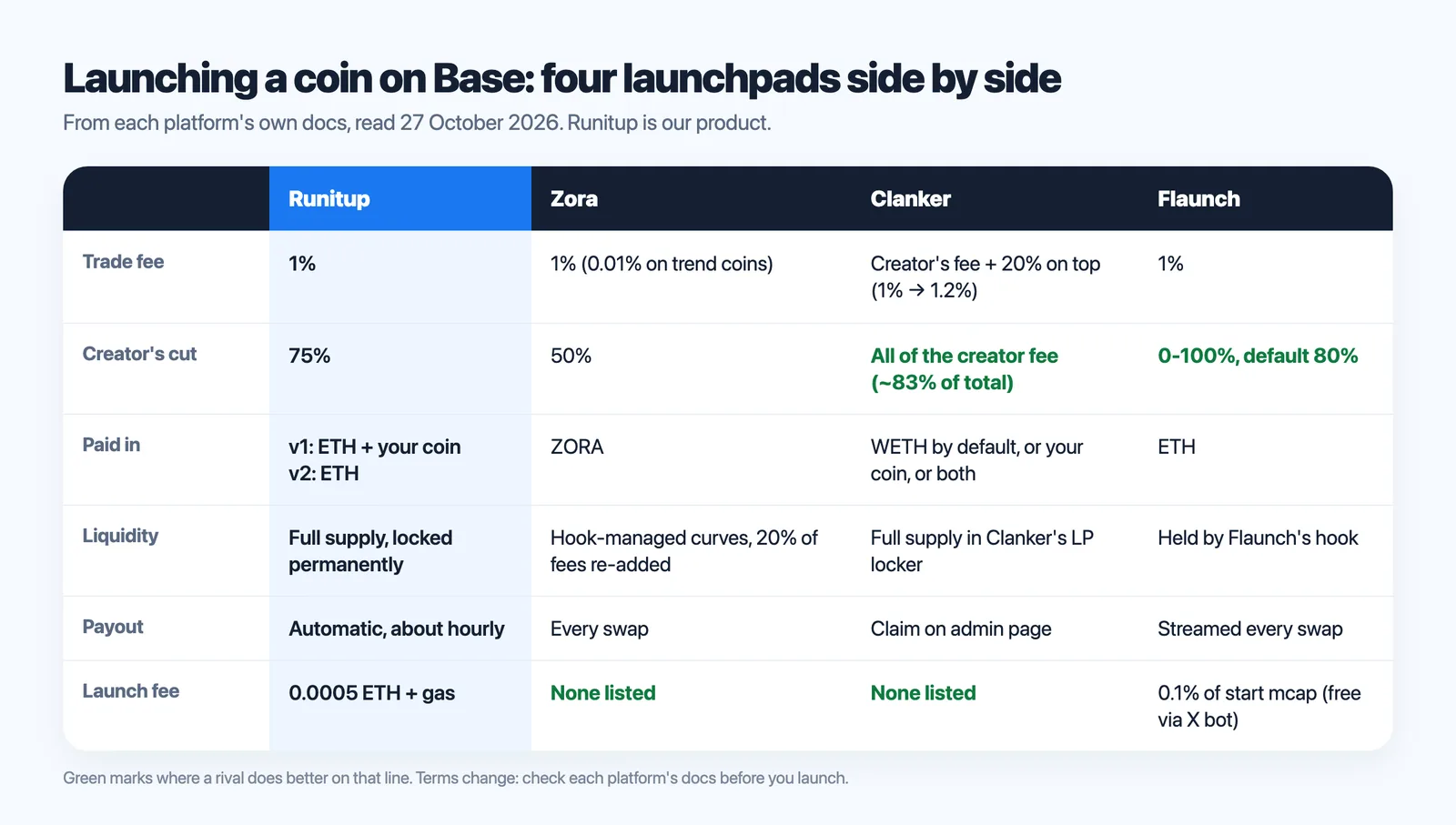
These are the three names most people already know for a coin on Base. Every figure below is from each platform's own documentation, read on 27 October 2026. Terms change, so check their docs before you choose.
| Runitup (ours) | Zora | Clanker | Flaunch | |
|---|---|---|---|---|
| Trading fee | 1% | 1% on creator and content coins, 0.01% on trend coins | The creator's chosen fee, plus 20% of it on top for Clanker (1% becomes 1.2%) | 1% on buys and sells |
| Creator's cut | 75% of the fee | 50% of the fee on creator and content coins, none on trend coins | All of the creator's chosen fee (1% of a 1.2% total, about 83%) | Creator chooses 0% to 100%, default 80% |
| Paid in | v1: ETH and your coin. v2: ETH | ZORA, converted from the fees on each swap | The paired token (usually WETH) by default, or your coin, or both | ETH |
| Liquidity | Full supply in one pool, locked permanently in Runitup's locker | Multi-curve positions run by Zora's hook, with 20% of fees added back as permanent liquidity | Full supply in a single-sided V4 position placed by Clanker's LP locker | Held by Flaunch's V4 hook; a launch can open with a fixed-price fair launch window |
| How you get paid | Automatic sweep about hourly, or collect yourself | Paid out on every swap | Claim on the token's admin page (anyone can trigger it) | Streamed on every swap, claimable at flaunch.gg |
| Launch fee | 0.0005 ETH plus gas | None listed in its docs | None listed in its docs | 0.1% of the starting market cap (SDK docs); launches through its X bot are free |
| Tokens set aside for the creator | None, only what your dev buy buys | Creator coins: 50% of supply, vesting over 5 years. Content coins: 10 million of 1 billion | Optional vault, minimum 7-day lockup | Optional premine during the fair launch |
Sources: Zora's coin rewards docs, Clanker's creator rewards and fees page and Flaunch's docs.
Where the rivals beat us
Flaunch lets the creator keep up to 100% of the trading fee, and pays it all in ETH. Its default 80% is more than our 75%. Clanker effectively gives the creator about 83% of the total swap fee, because its own cut is added on top rather than taken out. On creator share alone, both beat Runitup.
Zora and Clanker list no launch fee in their docs, and Flaunch's X bot launches for free. Ours is 0.0005 ETH, about $1.17. Small, but not zero.
They also have reach. Zora is a social app where posts can become coins, and Clanker launches from a Farcaster bot as well as its site. The Block reported that the "Clanker team earns $13 million in revenue from over 200,000 tokens on Base in just five months". A brand-new coin on Base gets more walk-up traffic on a platform people already browse.
Where Runitup is different
Our pool fee is the plainest of the four: one 1% fee, 75% to you, on a token that has no tax and no special transfer rules. Zora's creators get 50%.
Liquidity is locked permanently in the launch transaction, and the whole supply sits in the pool. Nothing is set aside for anyone, so there is no vesting allocation that can be sold later.
Payouts on Base happen automatically. Our Keeper sweeps every pool about once an hour and pays whoever the fee recipient is at that moment, so you never need to come back and claim. Collection is permissionless too, so you can also trigger it yourself from My Launches at any time.
And Runitup is multichain. The same form launches on Ethereum, BNB Chain, Arc and Robinhood Chain, so if your audience is somewhere else you do not need to learn a new site.
Mistakes to avoid when you launch a coin on Base
Most problems happen before you sign.
- ETH on the wrong network. ETH on Ethereum mainnet cannot pay for a coin on Base. Bridge it first.
- A ticker you will regret. The name and ticker are permanent. The image and description are not.
- The wrong fee recipient. It defaults to your wallet for a reason. Change it on purpose or not at all. It can be updated later from My Launches.
- Panicking at a scanner score. TokenSniffer's own docs list only Uniswap v2 and v3 among the DEXes it reads on Base, not Uniswap V4. A V4 coin on Base can get a bad score simply because the tool cannot find the pool. That applies to every V4 launchpad, not just ours.
- Expecting a bonding curve. There is no curve and no graduation. The coin trades on a real pool from the first block.
What you earn after you launch a coin on Base
On a Quick launch with the v1 pool fee, every trade pays 1%, and 75% of it is yours. If your coin does $10,000 of volume, you earn $75. Volume pays you, not price, so a coin that trades all day sideways can earn more than one that pumps on a few trades.
With the v1 model you receive a mix: ETH from buys and your own coin from sells. With v2 every fee arrives in ETH. The fees docs work through examples.
You can also split your 75% between several wallets when you launch, and change the split later. That is handy for teams, or for handing a project over to its community.
v1 or v2: which fee model to pick when you launch on Base
Both models charge traders the same 1%, so buyers will not notice the difference. What changes is what you receive and when.
| v1, pool fee | v2, hook fee | |
|---|---|---|
| Who charges the 1% | The Uniswap V4 pool itself | Runitup's hook, on a pool with no LP fee |
| Your share | 75% | 0.75% of volume, which is the same 75% |
| Paid in | ETH from buys, your coin from sells | ETH only |
| Liquidity others add | Earns part of the 1% | Earns nothing, so the whole fee stays with you and the platform |
| Your dev buy | Pays the 1% like any trade | Pays nothing |
| Sniper window | Not offered | Optional |
Pick v1 if you want the plainest possible pool, with nothing between the trader and Uniswap. Pick v2 if you would rather be paid only in ETH, or you want a sniper window so bots that buy your coin on Base in its first seconds pay you for the privilege.
One thing to know about v2: pools that use a hook are newer territory for some outside tools. Your coin on Base still trades on Runitup's own swap from the first block either way. If you are unsure, v1 is the safe default, and it is what the form selects for you.
Common questions about a coin on Base
How long does it take to launch a coin on Base?
A few minutes. Blocks on Base come about every two seconds, so the launch confirms almost as soon as you sign.
Do I need to code to launch a coin on Base?
No. The factory contract deploys the token for you. You fill in the form and sign one transaction.
Can I launch a meme coin on Base for free?
Not on Runitup: there is a 0.0005 ETH launch fee plus a few cents of gas. No liquidity is needed, so about $1.20 covers it before any dev buy.
Is the liquidity of a coin on Base locked?
Yes, permanently, from the same transaction that creates the pool. Every token page shows it in the Details tab.
Is a coin on Base cheaper than a coin on Ethereum?
Yes. The launch fee is the same 0.0005 ETH on both, but gas on Base cost about three cents for a real launch, against about 25 cents to $3 for most Ethereum launches we read this month, and about $19 for one that paid a big tip. Our Ethereum cost guide has the receipts.
Can I pair my coin on Base with something other than ETH?
On 27 October the launch form offered ETH as the only pair on Base. ETH is what most Base buyers hold anyway.
Before you launch
If your audience already lives on Zora's feed or Farcaster, the big Base launchpads have a real head start, and Flaunch and Clanker pay creators a bigger slice. If you want a plain token with permanently locked liquidity, a 75% fee share paid automatically, and the option to launch the same way on four other chains, Runitup is worth a look.
Either way, a coin on Base is cheap enough that you can try it first with something you do not mind losing. For the other chains, see how to launch a coin on Ethereum or the guides for Arc, BNB Chain and Robinhood Chain. When you are ready, open the launch page and pick Base.