How much does it cost to launch a coin on Ethereum? Search for it and you get numbers from another era: $50 to $300 in gas, $441 in gas, or agency quotes in the tens of thousands. Today the honest answer is about $2, plus whatever dev buy you choose.
That is not a guess. Below we read a real launch from the Runitup factory on Ethereum, show the exact gas it used and what it paid, and then show you how to check the price yourself before you sign anything. Gas moves, so the last part matters most.
If you just want the steps to launch a meme coin on Ethereum, skip to the five-step section. If you want to know why the old numbers were so high, and why they are so low now, read on.
How much does it cost to launch a coin on Ethereum today?
Here is the short version, measured on 27 October 2026.
| What you pay | Amount | In dollars (ETH at $2,340) |
|---|---|---|
| Runitup launch fee | 0.0005 ETH | about $1.17 |
| Network fee (gas) for the launch | about 0.00015 to 0.0002 ETH | about $0.35 to $0.45 |
| Liquidity you must supply | none | $0 |
| Dev buy | optional, your choice | $0 if you skip it |
| Total without a dev buy | about 0.00065 ETH | about $1.50 to $1.60 |
The launch fee comes straight from Runitup's live config, and it is the same 0.0005 ETH on Ethereum as on Base and Robinhood Chain. The gas line comes from a real launch, which we look at next. The liquidity line is the one people struggle to believe, so it gets its own section further down.
So when we say a coin on Ethereum costs about $2, we are rounding up. On a quiet day it is closer to $1.50. On a busy day, or with a wallet that adds a big tip, it can be more. That is why the last section of this guide shows you how to check.
A real coin on Ethereum, read off the chain
Numbers in blog posts are cheap. Transactions are not, so here is one you can open yourself.
On 19 October 2026 someone put a coin on Ethereum with a Quick launch through the Runitup factory (0x2C2600d576E5B1eD7b19A78817a000a1a945714a). The transaction is 0x6d8b627b…f620 on Etherscan. Here is what the receipt says:
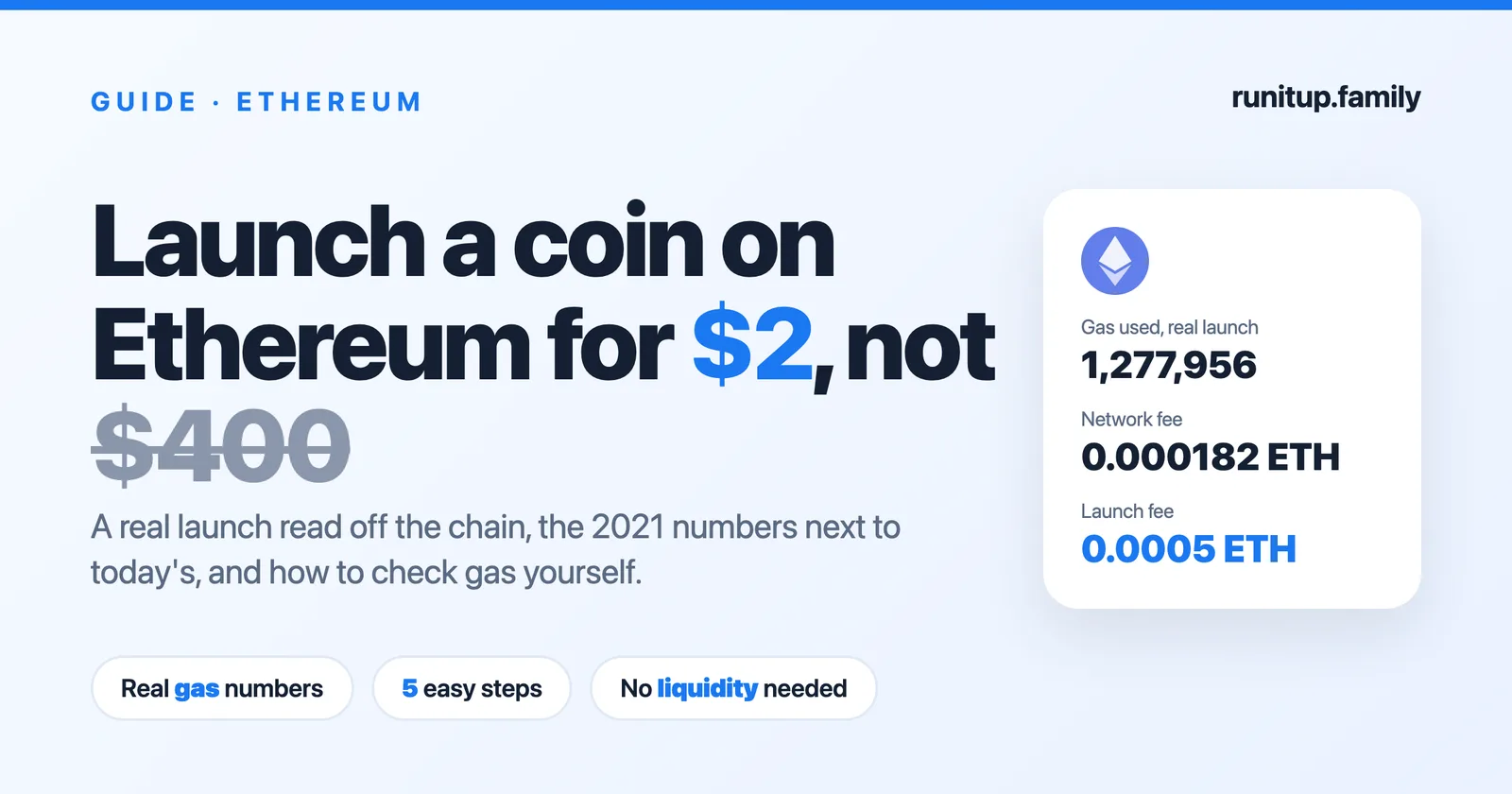
- Gas used: 1,277,956
- Base fee in that block: 0.042 gwei
- Tip the wallet added: 0.1 gwei
- Price actually paid: 0.142 gwei per unit of gas
- Network fee: 0.000182 ETH, about $0.43 at today's ETH price
- ETH sent with it: 0.0006 ETH, which is the 0.0005 ETH launch fee plus a tiny 0.0001 ETH dev buy
So the whole thing, minus the dev buy, came to about 0.00068 ETH. That is roughly $1.60.
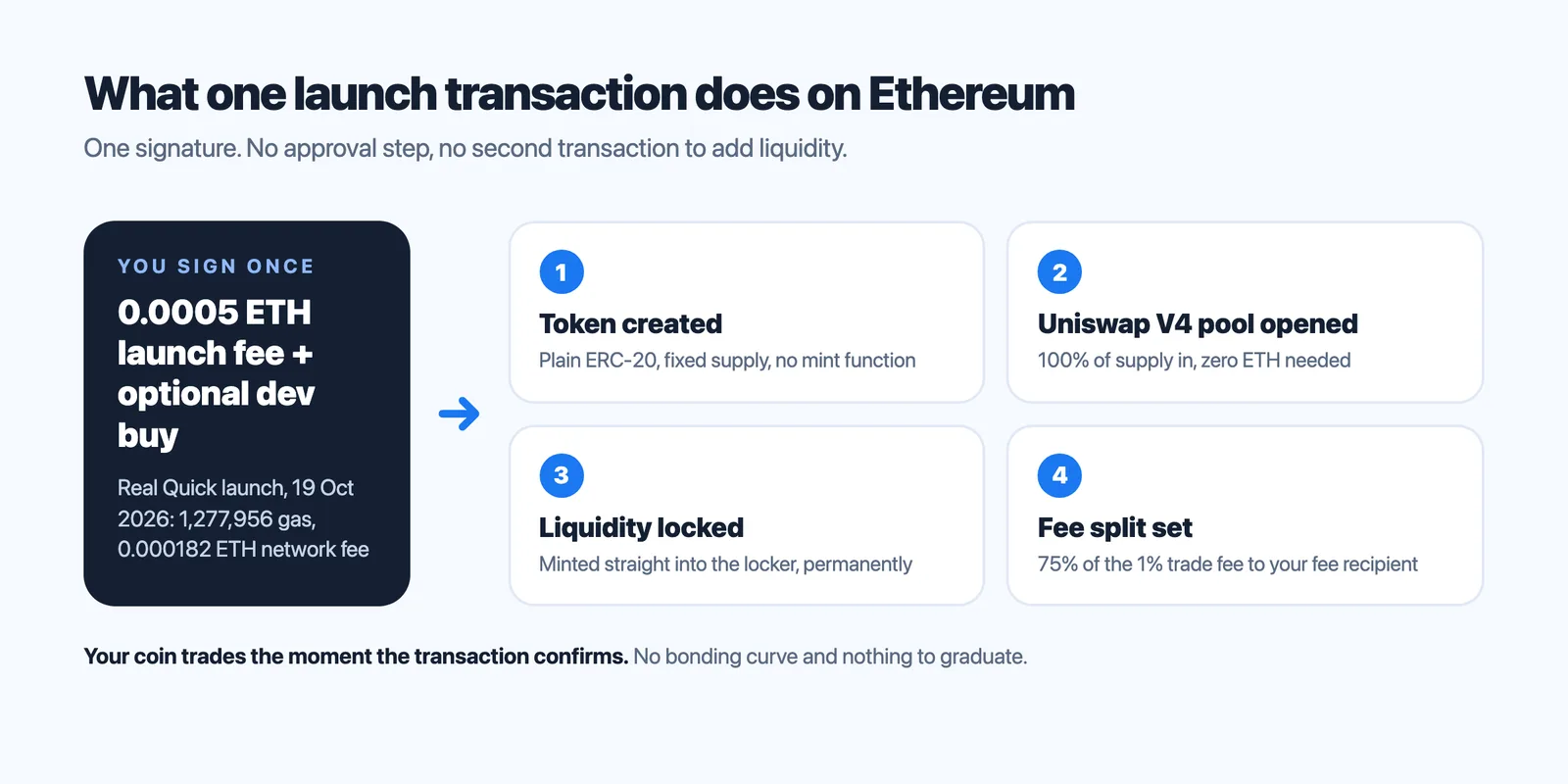
That single transaction did everything. It created the token, opened a Uniswap V4 pool holding the full supply, locked the liquidity and set up the fee split. There was no second transaction to add liquidity, and no approval step, because the launch fee and the dev buy were both paid in plain ETH.
A "gwei" is just a billionth of an ETH, the unit gas prices are quoted in. The base fee is set by the network and burned. The tip is extra you offer to get included, and your wallet picks it for you unless you change it.
The same kind of coin on Ethereum, a different day
Not every launch paid that little, and the reasons are worth knowing.
A Quick launch on 13 October used 1,142,020 gas, slightly less than the one above. But the wallet that sent it offered a tip of 0.9 gwei when the base fee was only 0.12 gwei. It paid 1.02 gwei per unit of gas, and the network fee came to 0.00117 ETH, about $2.73. Same kind of launch, more than six times the gas bill, almost entirely because of the tip.
An Advanced (taxed) launch earlier today, 27 October, is the extreme case. It used 3,521,185 gas, the base fee had risen to 0.36 gwei, and the wallet added a 2 gwei tip on top. The network fee was 0.0083 ETH, about $19. On 24 October, by contrast, an Advanced launch used 1,514,438 gas at 0.068 gwei and paid about $0.24.
The lesson is simple. The launch itself is cheap. What you pay for gas depends on the moment and on your wallet's tip setting, so look before you sign.
Why everyone else says it costs $50 to $400
The old numbers for a coin on Ethereum were not wrong when they were written. They are just stale.
In November 2021, Alchemy worked through what it would cost to deploy well-known contracts, using a gas price of 100 gwei and ETH at $4,500. At those prices, Alchemy calculated that redeploying the Shiba Inu token contract would cost $2,026. In May 2023, a Stockhead writer stopped short of deploying a joke memecoin when the gas fee came to US$441.
Two things changed since then. Gas prices on Ethereum fell by orders of magnitude, from tens or hundreds of gwei to a fraction of one gwei in every launch we looked at this month. And launchpads replaced the "write a contract, deploy it, then seed a pool" routine with a single transaction.
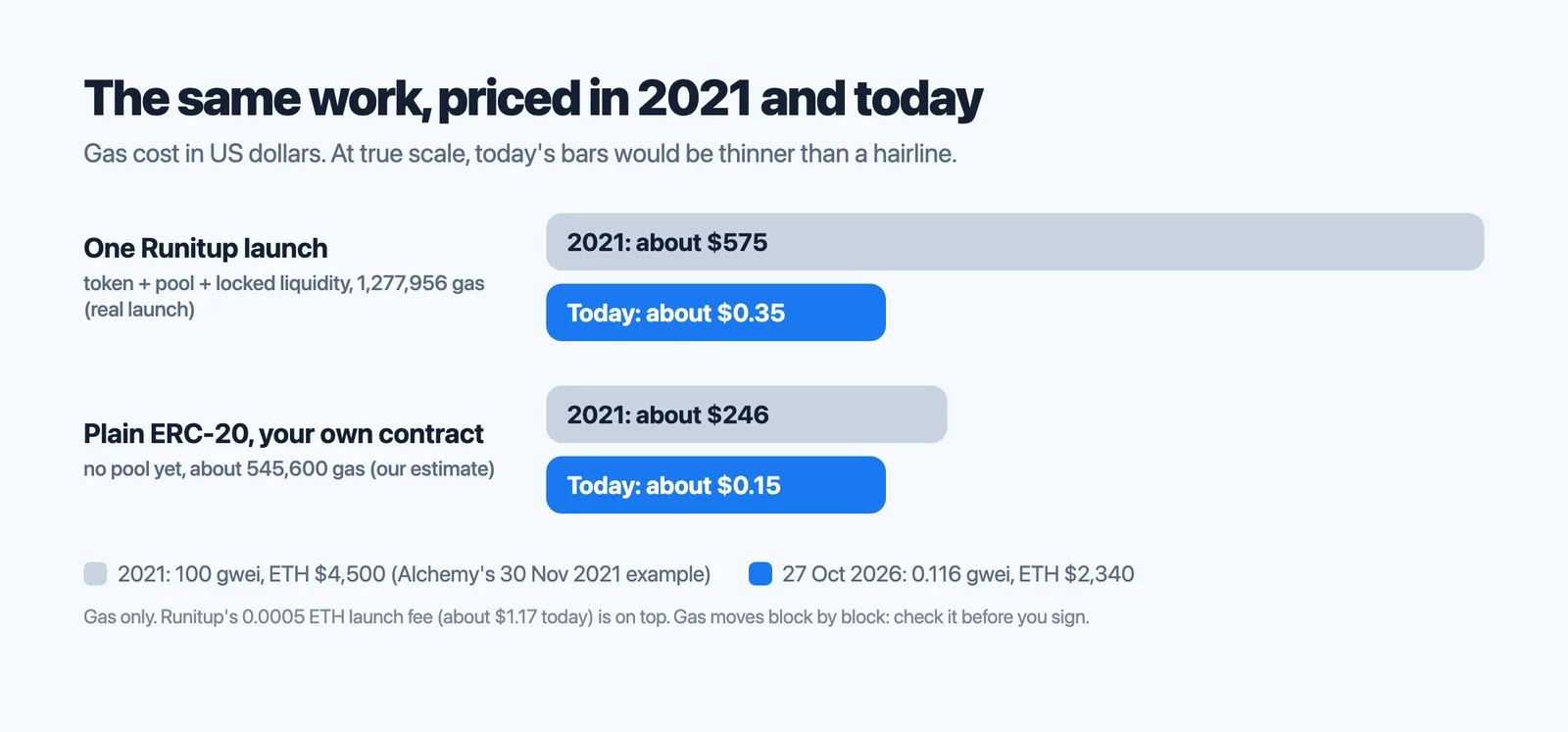
Here is the same work priced at 2021 levels and at today's.
| The job | Gas used | At 100 gwei, ETH $4,500 (Alchemy's 2021 example) | At 0.116 gwei, ETH $2,340 (27 Oct 2026) |
|---|---|---|---|
| Deploy a plain ERC-20 yourself, no pool yet | about 545,600 (our estimate) | about $246 | about $0.15 |
| One Runitup launch: token, pool and locked liquidity | 1,277,956 (real launch) | about $575 | about $0.35 |
| Runitup launch fee | not gas | not applicable | 0.0005 ETH, about $1.17 |
The plain ERC-20 figure is our own estimate. We compiled a standard OpenZeppelin token and asked an Ethereum node how much gas deploying it would take, without sending anything. The Runitup figure is the real receipt above.
Your own contract or a launchpad for a coin on Ethereum?
You can still do it the old way, and today it is cheap enough in gas that money is no longer the main reason not to. Here is the honest comparison.
| Write and deploy your own contract | Launch on Runitup | |
|---|---|---|
| Code | You write or copy an ERC-20 and deploy it, for example in Remix | A form, no code |
| Transactions | Several: deploy, create the pool, add liquidity, lock or burn the LP | One |
| Liquidity you supply | You pair ETH against your tokens yourself | None, the pool opens one-sided |
| Liquidity lock | Your job, and buyers will ask | Locked permanently in the launch transaction |
| Platform fees | None | 0.0005 ETH at launch, and 25% of the 1% trade fee |
| What you earn | LP fees on whatever liquidity you put in | 75% of the 1% pool fee on every trade |
Where the do-it-yourself route wins: nobody takes a cut, and you control every line of the contract. Where it loses: the real cost of a coin on Ethereum built this way is not the gas, it is the ETH you have to pair into the pool, plus the time and the chance of a mistake in a contract nobody has checked.
What "no liquidity" really means
When you launch a coin on Ethereum with Runitup, the pool opens holding 100% of your token supply and zero ETH. The position's lower edge sits at the opening price, so below that price it holds no ETH, and it does not need any. ETH only enters the pool as people buy. The single-sided pool docs walk through how that works.
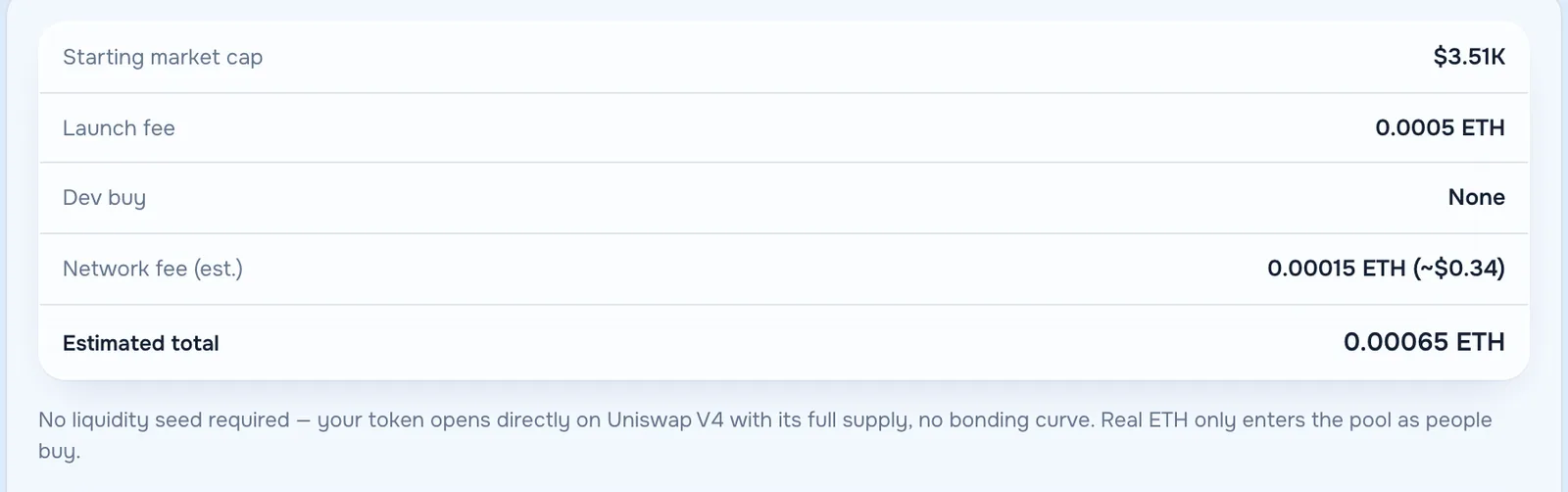
For an ETH pair, the starting market cap is fixed at 1.5 ETH, which the launch form showed as $3.51K today. That is the price your first buyer pays into.
How to launch a meme coin on Ethereum in 5 steps
Putting a coin on Ethereum takes a few minutes. You need a wallet with a little ETH on Ethereum mainnet, and that is it.
1. Put a little ETH in your wallet on Ethereum
To launch a coin on Ethereum you need the 0.0005 ETH launch fee plus gas. Today 0.001 ETH covers it with room to spare, which is about $2.34. If you want a dev buy, add that amount on top.
Make sure the ETH is on Ethereum mainnet itself, not on Base, Arbitrum or another layer 2. Your wallet shows the network at the top. ETH sitting on another chain cannot pay for a coin on Ethereum.
2. Open the launch page and pick Ethereum
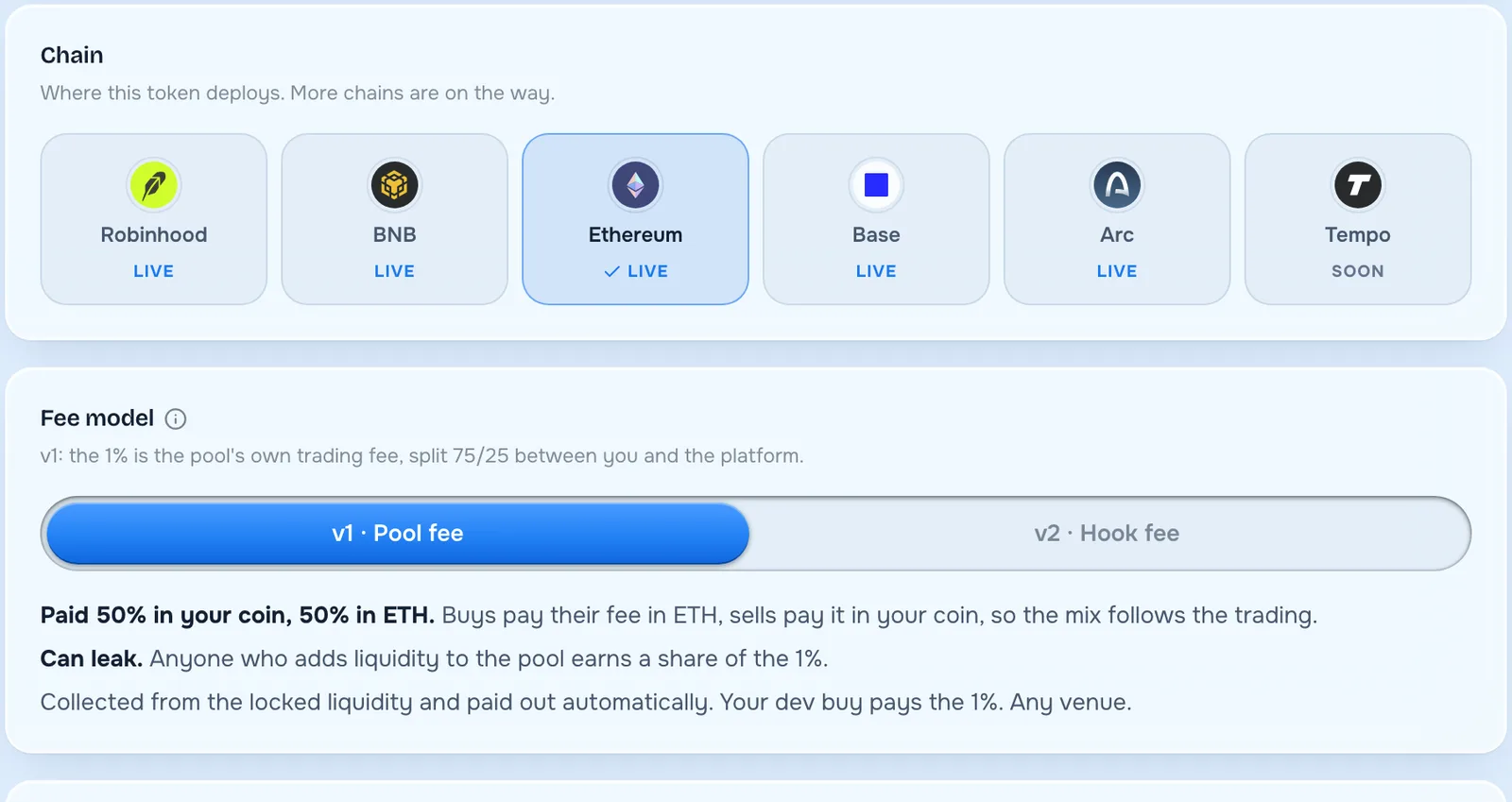
Go to the Runitup launch page and tap the Ethereum tile under Chain. Runitup is live on five chains, so check the tick lands on the right one before you go further.
Leave the launch type on Quick unless you want a taxed token. Quick is a plain token with one 1% trade fee and nothing taken on transfers.
3. Name, ticker and picture
Only four things are required to launch a coin on Ethereum here: a name, a ticker, a total supply (pre-filled) and a fee recipient (pre-filled with your wallet). The image, description and socials are optional and can be edited later.
The name and ticker cannot be changed after launch. Read them twice.
4. Choose the fee model, pair and dev buy
On Ethereum the form gives you two fee models, both charging traders 1%:
- v1, pool fee. The 1% is the pool's own fee, split 75/25 between you and the platform. Buys pay their fee in ETH and sells pay it in your coin, so you earn a mix of both.
- v2, hook fee. A Uniswap V4 hook charges the 1% on a pool with no LP fee, 0.75% to you and 0.25% to the platform, and every fee arrives in ETH. It also lets you switch on a sniper window.
Uniswap V4 is the only venue on Ethereum. For the pair you can pick ETH or USDC. ETH is the usual choice, because it is what buyers already hold.
The dev buy is optional. It buys some of your own coin inside the launch transaction, so nothing can trade ahead of you. Whatever you buy shows publicly as "Creator holds" on your token page.
5. Read the cost panel, check gas, then confirm
Before the button, the form shows the starting market cap, the launch fee, your dev buy, a network fee estimate and the estimated total. When we checked on 27 October it showed a network fee of 0.00014 ETH (about $0.33) and a total of 0.00064 ETH.
Then your wallet pops up with its own fee. Compare the two. If the wallet's number is several times the form's estimate, the tip is probably set high. More on that below.
Sign, and your coin on Ethereum is live and trading the moment the transaction confirms, on a real Uniswap V4 pool. No bonding curve, nothing to graduate.
Gas moves: check the price yourself
Every dollar figure in this post was true when we measured it. Gas on Ethereum changes block by block, and the price of ETH changes all day. So here is how to check the cost to launch a coin on Ethereum on the day you do it.
Look up the current gas price. The Etherscan gas tracker shows the current base fee and typical tips in gwei. Any wallet shows it too.
Do the sum. Gas used × gas price in gwei ÷ 1,000,000,000 = the network fee in ETH. A Quick launch used about 1.28 million gas. At 0.2 gwei that is 1,280,000 × 0.2 ÷ 1,000,000,000 = 0.000256 ETH. Multiply by the ETH price for dollars.
Add the launch fee. 0.0005 ETH, which you can confirm on the cost panel or in the launching docs.
Watch the tip. Your wallet's "priority fee" or "tip" is the part you control. On a quiet network a small tip still gets you in quickly. The 13 October launch above paid nine times the tip it needed and more than six times the gas.
Glance at the form's estimate. The launch form prices the network fee for you before you connect anything. If it says cents, you are in a cheap window.
A rough guide: if the base fee is under 1 gwei, a launch costs well under a dollar in gas. If you ever see tens of gwei again, wait, or launch somewhere cheaper.
A coin on Ethereum or a cheaper chain?
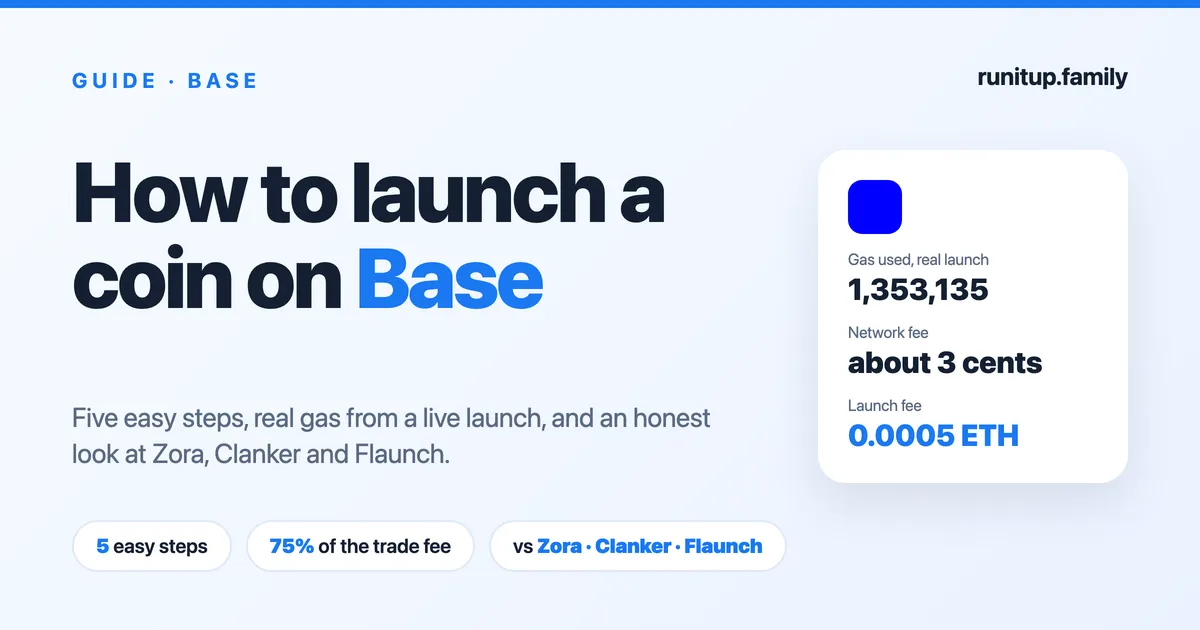
Ethereum is the most expensive of Runitup's five chains to launch on, even now. For comparison, a launch on Base on 23 October used 1,353,135 gas at about 0.01 gwei, and the whole network fee was about 0.0000136 ETH, around three cents.
So why launch a coin on Ethereum at all? Because that is where a lot of the money and attention still sits, and some buyers prefer to trade on mainnet. A coin on Ethereum also reads differently to people: it is the original chain, and the extra dollar of gas is a rounding error next to any serious dev buy.
If cost is everything, look at the other guides. Here is how to launch a coin on Base, and there are step-by-step posts for Arc, BNB Chain and Robinhood Chain.
What a coin on Ethereum earns you after launch
Every trade of a Quick-launched coin on Ethereum pays a 1% fee, and 75% of it is yours. On $10,000 of trading volume that is $75 to you. Volume pays you, not price, so a coin that trades sideways all day can earn more than one that pumps on two trades.
The fees build up in the locked position until they are collected. You can collect them any time from My Launches, paying the gas yourself, which on Ethereum today is cents. Collection is permissionless: it is written into the contract, so anyone can trigger it and it always pays the current fee recipient. You never depend on Runitup being online to get your money. The fees docs have worked examples.
The liquidity is locked permanently. The position is minted straight into a locking contract in the launch transaction, with no unlock date and no admin key that releases it.
Common questions about a coin on Ethereum
Do I need to code to launch a coin on Ethereum?
No. The factory contract deploys the token for you. You fill in a form and sign one transaction.
Can I launch a meme coin on Ethereum with $5?
Yes, on a normal day. The launch fee is about $1.17 and gas has been well under a dollar for a Quick launch at recent prices. Anything left over can go into a dev buy. If gas spikes, wait.
Why did my wallet show a bigger fee than the form?
Usually the tip. Wallets sometimes suggest a priority fee far above what a quiet network needs. You can lower it in the wallet's advanced or custom gas settings, at the risk of waiting a little longer to be included.
Is the liquidity of a coin on Ethereum really locked?
Yes. It is locked in the same transaction that creates the pool, and every token page shows it under Details. You can check the locker contract on Etherscan.
Can I rename my coin on Ethereum later?
No. Name, ticker, supply, pair and venue are permanent. The image, description, socials and fee recipient can be changed after launch.
Before you launch
Two years ago the honest advice was that launching a coin on Ethereum was a luxury. Today the gas is often cheaper than a coffee, and the launch is one transaction.
Check the gas price, check your wallet's tip, and read the cost panel before you sign. If the numbers look like the ones in this post, it costs about $2 to put a coin on Ethereum, with the liquidity locked and 75% of every trade's fee paid to you. Start on the launch page when you are ready.