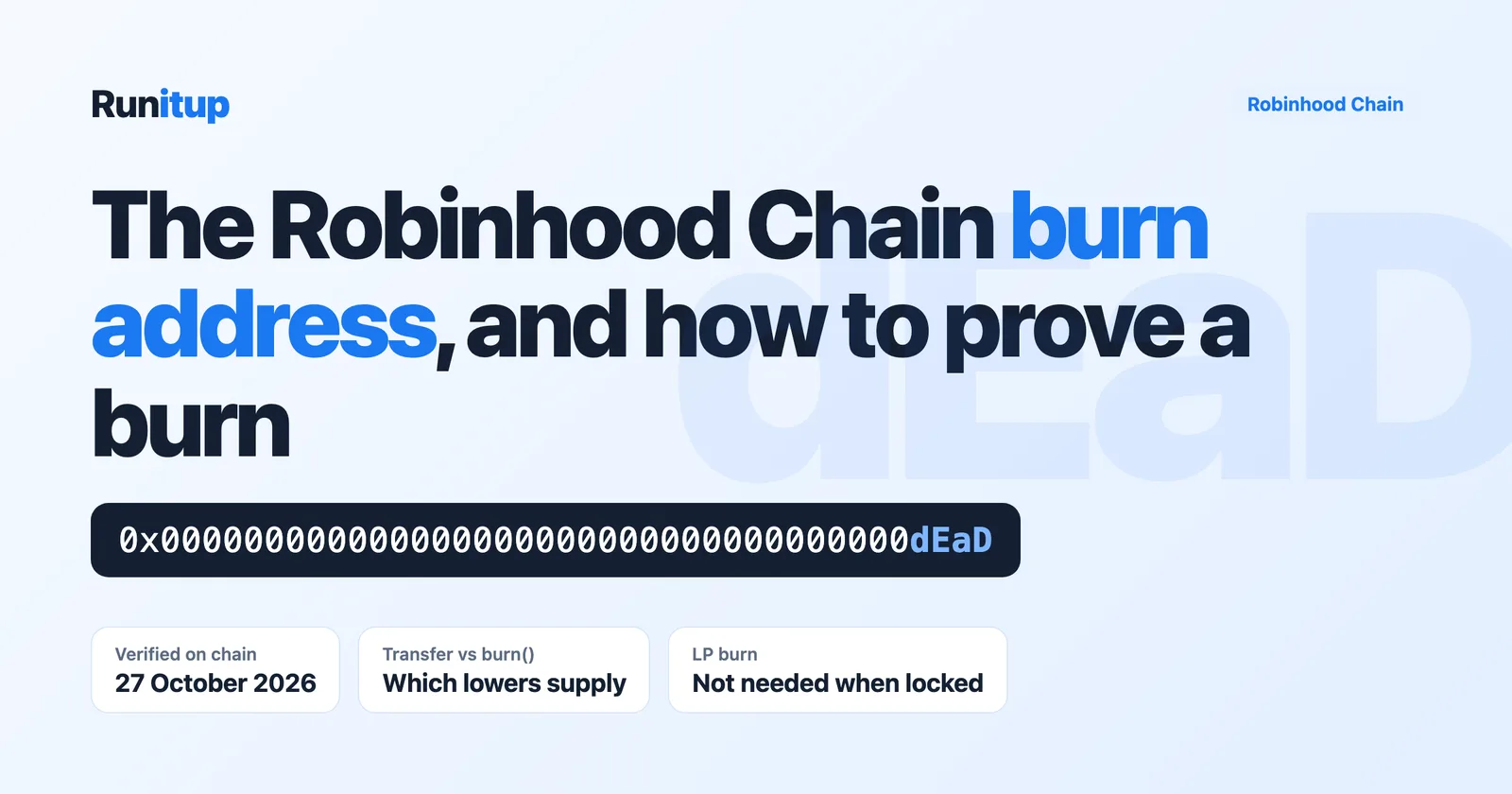
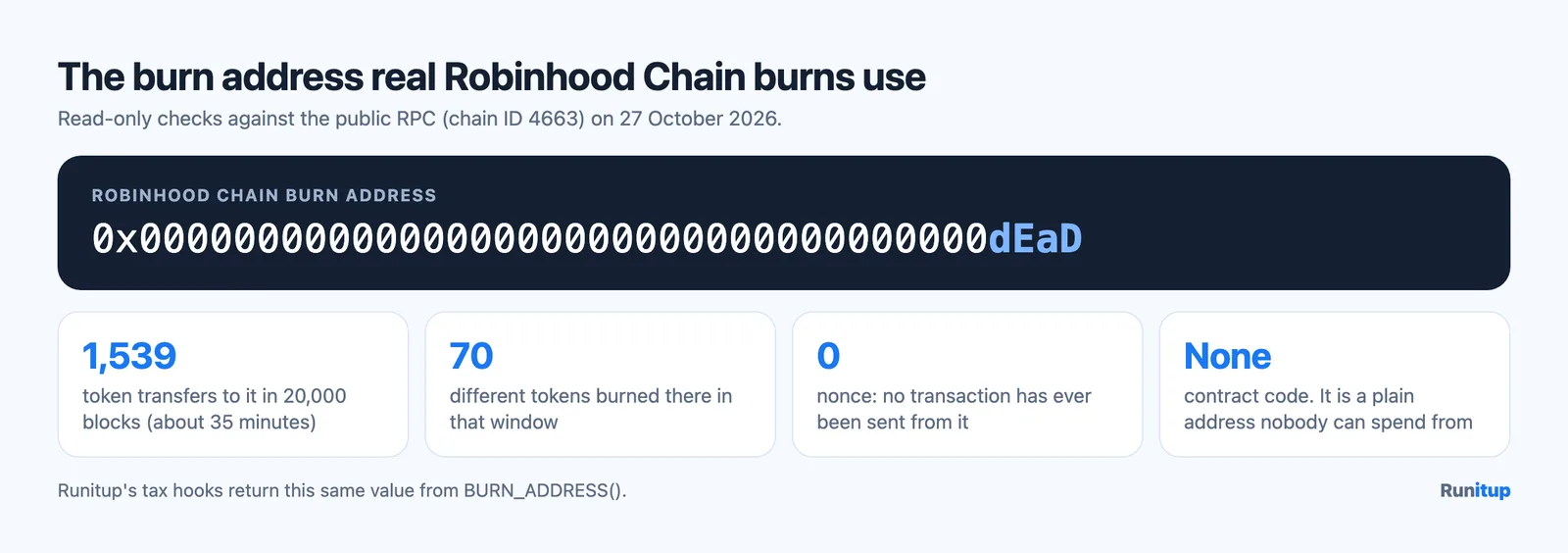
The Robinhood Chain burn address is 0x000000000000000000000000000000000000dEaD. That is the address real token burns on Robinhood Chain are sent to, and we checked it on chain rather than copying it from another network's docs. This guide shows you how we checked, what a burn address actually does, and how to prove any burn yourself on the explorer.
You will also learn the difference between sending tokens to a dead address and calling a real burn() function (they look the same on a chart and are not the same on chain), and why a team with locked liquidity has no reason to "burn the LP."
Quick note: we run Runitup, a token launchpad on five chains, including Robinhood Chain. We use our own coins as worked examples because we can show every number, but the checks work on any token.
The Robinhood Chain burn address, verified on chain
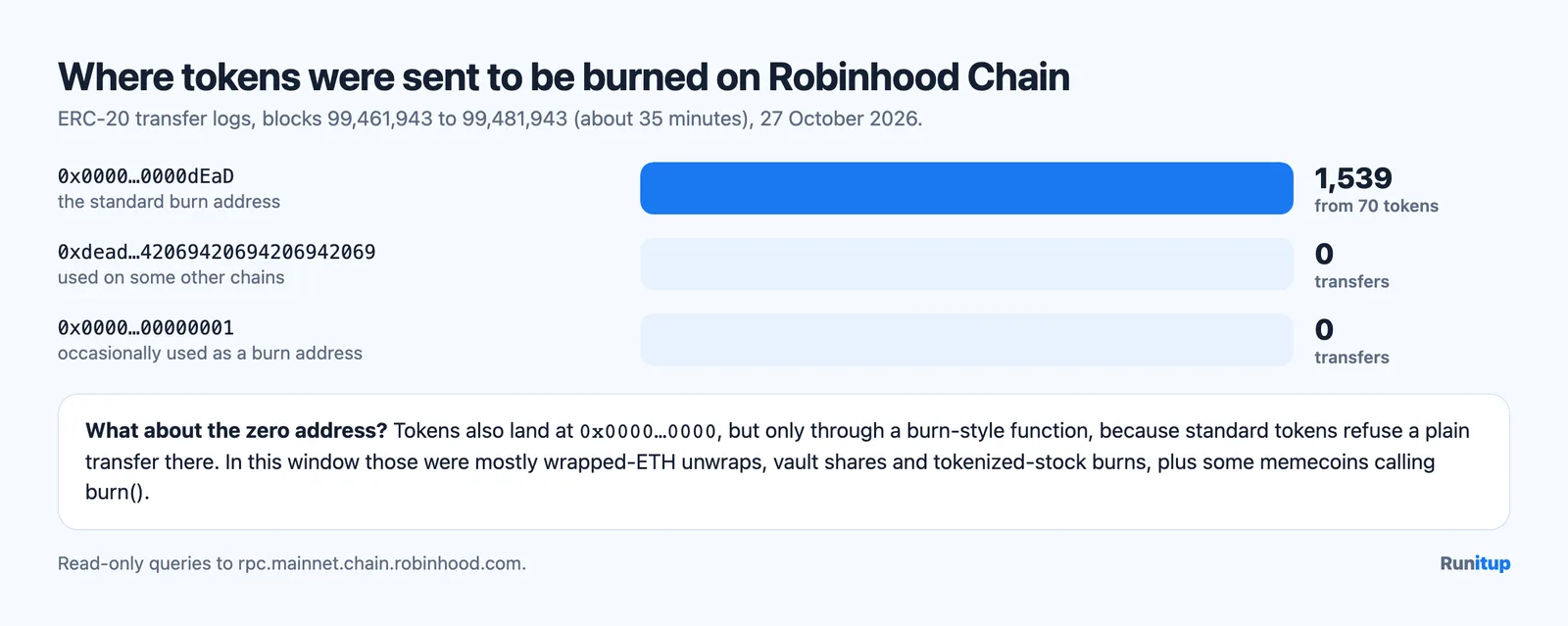
On 27 October 2026 we pulled every ERC-20 transfer log on Robinhood Chain over a window of 20,000 blocks (blocks 99,461,943 to 99,481,943, about 35 minutes of chain time) and counted where tokens were being sent to die. These were read-only queries against the public RPC, rpc.mainnet.chain.robinhood.com.
Here is what came back:
0x000000000000000000000000000000000000dEaD: 1,539 token transfers from 70 different tokens in those 35 minutes.0xdead000000000000000042069420694206942069, a burn address some other chains use: zero transfers.0x0000000000000000000000000000000000000001: zero transfers.
So when someone on Robinhood Chain says they "sent it to the burn address," it is the ...dEaD one. Our own taxed launches agree: the tax hook contract has a BURN_ADDRESS value, and reading it on chain from both of our live hooked suites returns 0x000000000000000000000000000000000000dEaD.
The same address is the standard burn address on Ethereum and most chains built like it. It is just a number that happens to spell a word in hexadecimal, so it exists on every one of those chains at once. Nobody is known to hold its private key, and finding one by guessing is, for practical purposes, impossible.
You can check two more facts yourself. On Robinhood Chain the burn address has no contract code, and its nonce (the count of transactions ever sent from it) is 0. A nonce of 0 means nothing has ever left that address on this chain. People have also sent it about 2.5 ETH over time, which is gone for good too.
What a burn address is, in plain words
A burn address is a wallet address that nobody can spend from. Tokens sent there still exist on paper, but nobody will ever move them again. That is what "burned" means in practice: permanently out of circulation.
Why do people burn tokens? A few common reasons:
- To shrink the tradable supply. Fewer tokens in circulation means each remaining one is a bigger share of the whole.
- To make a public promise. A dev who burns part of their own bag is showing they cannot sell it.
- As part of a tax. Some tokens buy themselves back from the pool with part of every trade and send what they buy to the burn address.
None of these guarantee a price. Burning makes the supply smaller. Whether the price moves depends on whether anyone wants to buy.
Dead address transfer vs a real burn() function
There are two different ways to burn a token, and they leave different evidence on chain. People often call the burn address the "dead address" because of how it ends, so you will see both names.
Sending tokens to the burn address
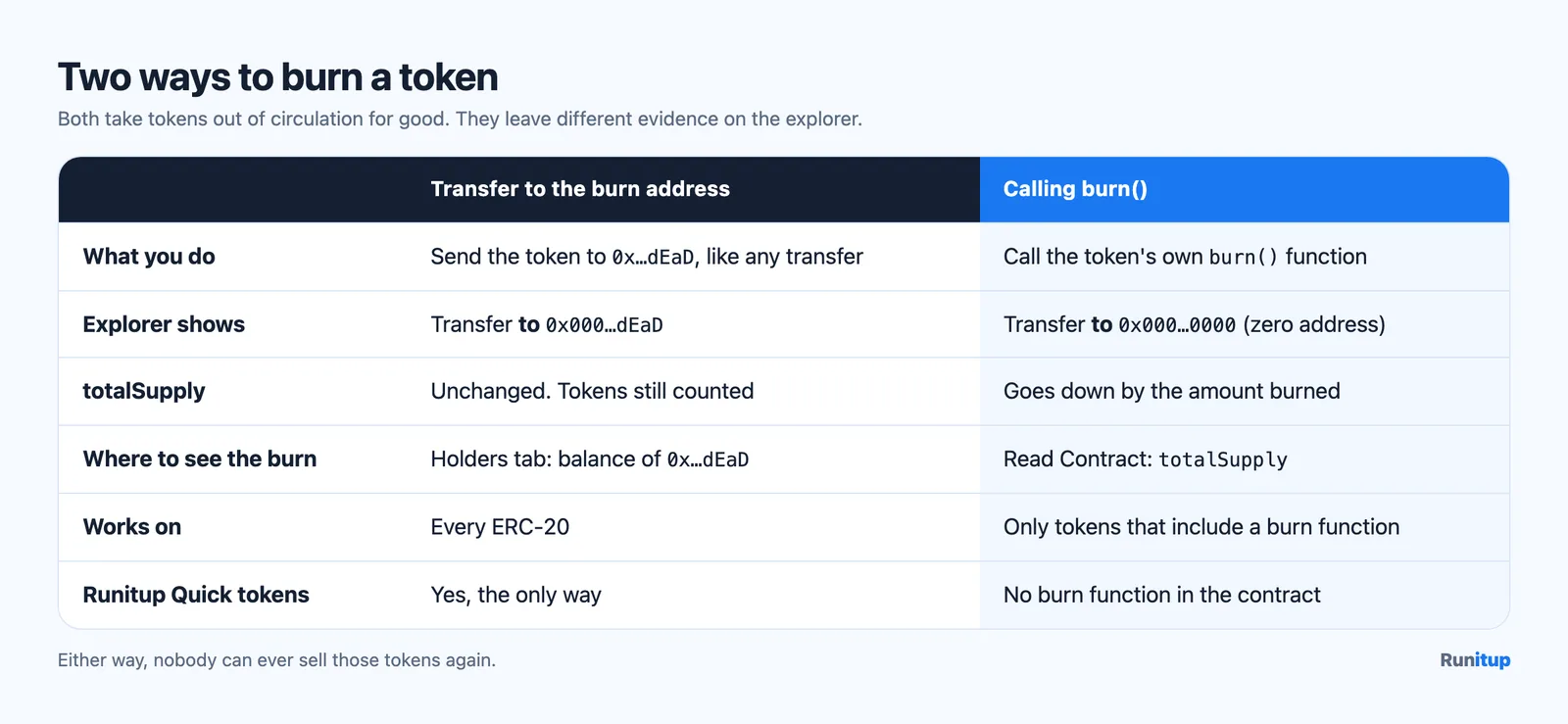
This is an ordinary transfer, the same thing your wallet does when you send a token to a friend. The only difference is the recipient: 0x...dEaD.
What changes on chain: the burn address's balance goes up by the amount you sent. What does not change: the token's totalSupply, the number the contract reports as the total that exists. The tokens are still counted. They are just sitting where nobody can reach them.
Any token can be burned this way, because every ERC-20 can be transferred. That matters on Runitup: a Quick launch token is a plain ERC-20 with no burn() function at all, so a transfer to the burn address is the only way to burn one.
Calling burn()
Some token contracts include a burn() function. Calling it destroys the tokens outright. The contract lowers your balance and lowers totalSupply by the same amount. On the explorer, the transaction shows a transfer to the zero address, 0x0000000000000000000000000000000000000000.
Why the zero address and not ...dEaD? Because by convention, a transfer log "to" the zero address means "destroyed," just as a transfer "from" it means "created." Most standard tokens, including the widely used OpenZeppelin ERC-20, refuse a plain transfer to the zero address. So when you see tokens arrive at the zero address, a burn function did it.
A real example from the same 35-minute window: a token called Boomer (not one of ours) had a holder call burn() in transaction 0x1781abbdb231eda8568591940d3ad0eb3d43821b45c0ad97c748037a48177fee. The receipt holds exactly one log: a transfer of 1,926,029.46 BOOMER from the holder to the zero address.
Which kind is better for the total supply?
For you as a holder, the effect is the same: those tokens can never be sold. The difference is in how the numbers show up in the total supply.
- After a burn address transfer,
totalSupplystays the same, and you have to subtract the burn address's balance yourself to see the real circulating supply. - After a burn() call,
totalSupplyalready reflects it.
Some trackers do the subtraction for you and some do not. So when two sites show different supplies for the same coin, a burn address balance is the usual reason.
How to prove a burn on the explorer, in 3 steps
Anyone can post "we burned 10%!" with a screenshot. Here is how to check it in a couple of minutes on robin.etherscan.io (Blockscout at robinhoodchain.blockscout.com shows the same data).
Step 1: open the transaction
Ask for the transaction hash, or find it on the token page. In the transaction details, look at the token transfer line:
- To
0x000000000000000000000000000000000000dEaDmeans a burn address transfer. - To
0x0000000000000000000000000000000000000000means aburn()call. - To anything else means it was not a burn, whatever the post says. Watch for addresses that only look similar, like a normal wallet that happens to start with
0xdead. The real burn address is 36 zeros followed bydEaD.
Also check the token contract address in that line matches the coin you care about. A burn of a copycat token with the same ticker proves nothing.
Step 2: check the balance or the supply
For a burn address transfer, open the token page, go to the Holders tab, and find 0x...dEaD. Its balance is the total ever burned that way. For a burn() call, open Read Contract and call totalSupply. It should be lower than the launch supply by the amount burned.
Step 3: confirm the tokens cannot come back
For 0x...dEaD, that is the nonce check above: 0 outgoing transactions, ever. For the zero address, there is nothing to check, because burned tokens no longer exist. If someone "burned" tokens to a contract instead, ask why, and read that contract. A contract can have a function to send them back out.
A worked example: Fast Cat's burned supply
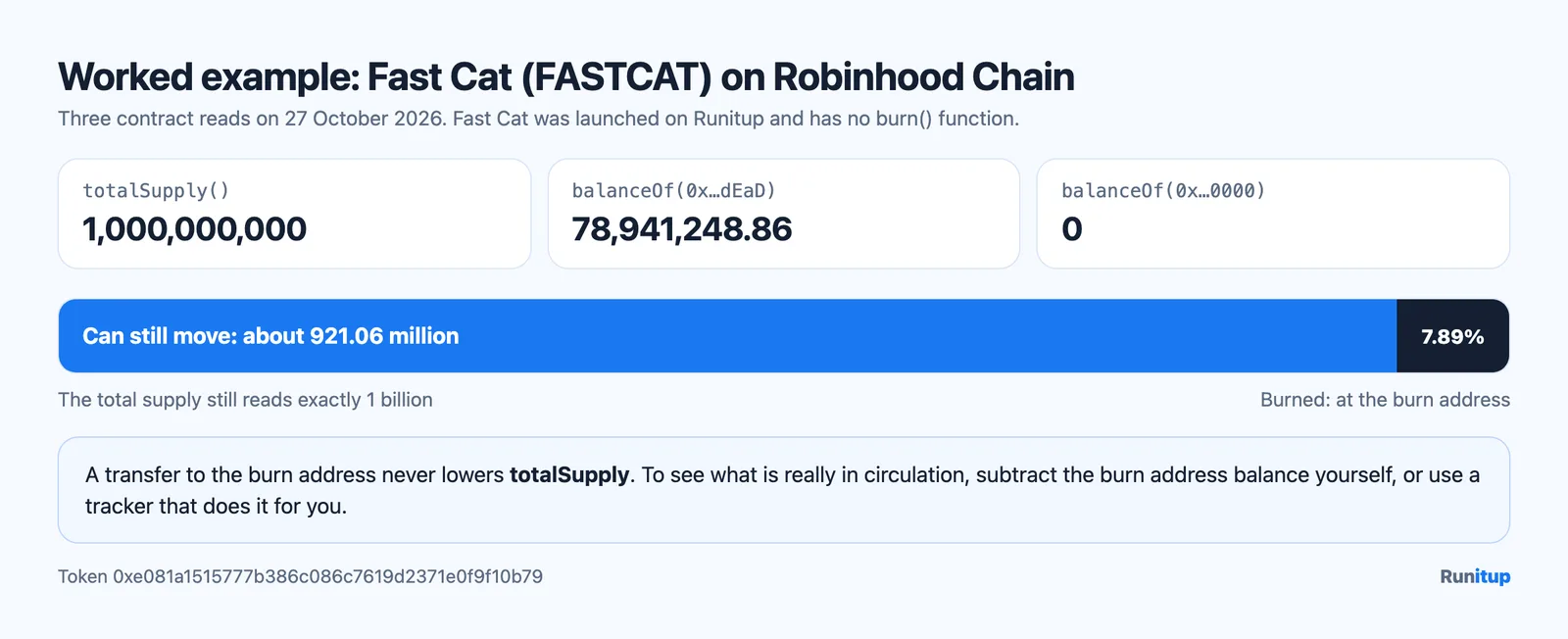
Fast Cat (FASTCAT) is a coin launched on Runitup on Robinhood Chain. Its token has no burn() function, so everything burned so far was sent to the burn address. These are the numbers we read on chain on 27 October 2026:
| What we read | Result |
|---|---|
totalSupply() | 1,000,000,000 FASTCAT |
balanceOf(0x...dEaD) | 78,941,248.86 FASTCAT |
| Share burned | 7.89% |
balanceOf(0x000...000) | 0 |
Has a burn() function | No |
Notice the first line. The supply is still exactly 1 billion, because a burn address transfer never lowers totalSupply. The 7.89% is real, but you only see it by checking the burn address balance. Subtract it and about 921 million FASTCAT can still move.
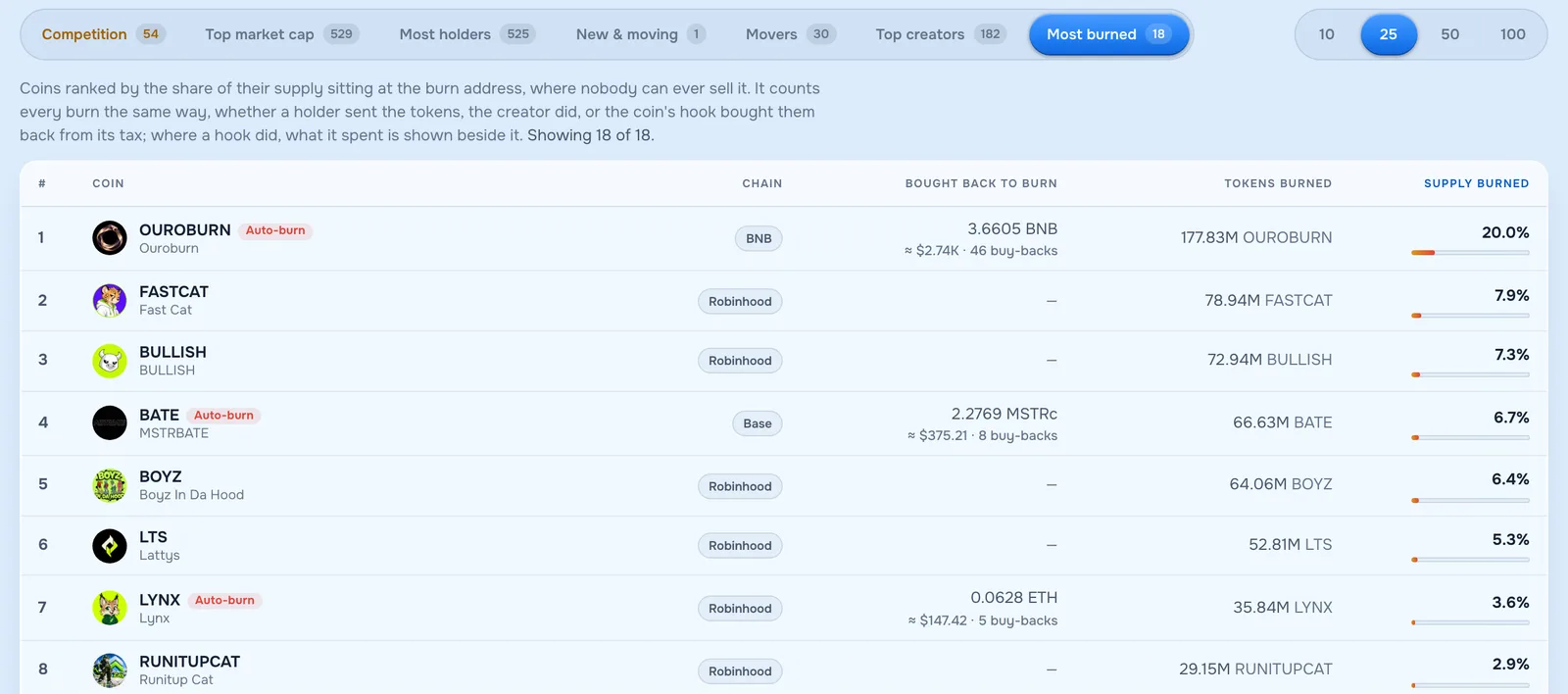
Runitup does that subtraction for you. Our holder tables label the burn address row "Burned" and leave it out of the holder count, and the burn leaderboard ranks coins by the share of their supply that has been burned. FASTCAT was second on it when we checked, behind a coin on another chain.
Automatic burns: a tax that buys back and sends to the burn address
Not every burn is a person pressing Send. Some tokens burn a little with every trade. The usual design: part of a buy or sell tax is set aside in ETH, used to buy the token back from its own pool, and the tokens bought are sent to the burn address. That is called a buyback and burn.
Runitup's Advanced launches can do this. A creator who sets a tax can send a share of it to Burn, and our fees and tax docs describe it in one line: the share is "used to buy the token back from the pool. The tokens bought are sent to a dead address." The dead address in question is the same 0x...dEaD, read straight from the hook contract.
Two details from the same docs are worth knowing, because they explain what you see on the explorer:
- Burns happen in batches, not on every trade. The burn share waits in the quote asset (usually ETH) until the protocol's keeper converts it. So you will see occasional buyback transactions, each followed by a transfer to the burn address, rather than a tiny burn inside every swap.
- Each buyback is capped. One conversion can move the price by about 2% at most, so a large balance is bought back over several steps instead of in one lump that someone could trade against.
A live example: LYNX, an Advanced coin launched on Runitup on Robinhood Chain, sends part of its tax to Burn. On 27 October 2026, 35,839,963.58 LYNX sat at the burn address, 3.58% of its 1 billion supply, and our burn leaderboard showed five buybacks so far. Like FASTCAT, its total supply still reads exactly 1 billion, because a buyback and burn is a dead address transfer too.
4 burn claims worth double-checking
Burns get announced a lot in memecoin chats. These are the four claims that most often mean less than they sound like:
- "The dev burned their bag." Check the "from" address in the burn transaction. Is it really the wallet that created the token, or that received the dev's allocation? A burn from some other wallet says nothing about the dev. And a dev can burn one wallet while holding others.
- "50% burned at launch." That only means the coin started with half its supply at the burn address. Compare the dead address balance with the total supply yourself. It changes the numbers on the chart, not how much anyone has to pay to buy.
- "Burned" to a contract or a multisig. That is not a burn. A contract can have a function that sends the tokens back out, and a multisig is just a wallet with several keys. Only
0x...dEaDor the zero address count. - "LP burned, so it's safe." That covers the pool and nothing else. Read the next section for what an LP burn does and does not do.
Why an LP burn isn't needed when liquidity is locked
"LP burned" is one of the most repeated safety claims in memecoin chats. It is worth knowing what it means, and when it is pointless.
When a coin's pool is created, whoever adds the liquidity gets a receipt for it. On older pools (V2-style) that receipt is an LP token. On Uniswap V3 and V4 it is an NFT position. Whoever holds the receipt can withdraw the liquidity. So the goal is always the same: make sure nobody holds a receipt they can cash in.
Sending the receipt to the burn address does that. So does putting it in a locker contract that has no withdraw function at all. Both make the liquidity permanent. Here is why the locker is often the better of the two:
- Fees keep flowing. A V3 or V4 position earns trading fees. If the NFT sits at
0x...dEaD, nobody can ever collect those fees again. They pile up in the pool forever. A locker can let anyone collect the fees while the liquidity itself stays stuck. - "Burn" means something else on V3. On Uniswap V3's position manager,
burn()destroys a position NFT, and it only works once the position's liquidity has already been removed. So "we burned the LP" on V3 can, in the worst reading, describe a pool that was emptied first. Always check which one happened. - There is nothing extra to burn. If the receipt was minted straight into a no-withdraw locker in the launch transaction, there is no moment where anyone held it, and no second step to trust.
That last one is how Runitup does it. Every coin's LP position is minted directly to our liquidity locker in the launch transaction, and the locker has no withdraw function. For a Quick launch on Robinhood Chain you can confirm it in two reads on robin.etherscan.io: call positionOf on the locker with the coin's pool id, then ownerOf on the position manager with the number you get back. The answer is the locker's own address. The liquidity lock docs list the addresses and walk through it.
A lock, or an LP burn, only protects the pool. It does not stop large holders selling into it. For the checks that cover that side, see our Robinhood Chain rug pull checker guide.
How to burn your own tokens on Robinhood Chain
If you want to burn tokens you hold, the simplest method works on every token:
- Open your wallet and choose Send for the token.
- Paste
0x000000000000000000000000000000000000dEaDas the recipient. Copy it from a source you trust, then check the start and end characters. - Enter the amount, confirm, and pay the small gas fee in ETH.
- Open the transaction on the explorer and do the 3-step check above on your own burn.
This cannot be undone. Start with a small amount if you have never done it before, and never send ETH or anything you might want back.
If the token has a burn() function and you want totalSupply to drop as well, you can call it from the token's Write Contract tab on the explorer, but only on a verified contract you have read. A burn address transfer is the safer default.
Burn address FAQ
What is the burn address on Robinhood Chain?
0x000000000000000000000000000000000000dEaD. In our 35-minute sample it received 1,539 token transfers from 70 tokens, and the other burn addresses we checked received none.
Is the zero address a burn address too?
Tokens can't normally be sent there with a plain transfer. When they show up there, a burn() function destroyed them, and totalSupply went down. Runitup counts both addresses as burned; other trackers vary.
Why does the total supply not go down after a burn?
Because the tokens went to the burn address by transfer. They still exist and are still counted in totalSupply. Check the dead address's balance in the Holders tab to see how much is gone.
Can tokens at the burn address ever come back?
Not in any realistic way. Nobody is known to have the private key, the address has never sent a transaction on Robinhood Chain, and guessing a key is practically impossible.
Does a burn make the price go up?
Not by itself. It makes the supply smaller. Price still depends on buyers.
Check the address every time
The Robinhood Chain burn address is 0x000000000000000000000000000000000000dEaD. Look for it in the transaction, check the Holders tab or totalSupply, and confirm the tokens cannot come back. Three steps, and no screenshot from a group chat can fool you again.