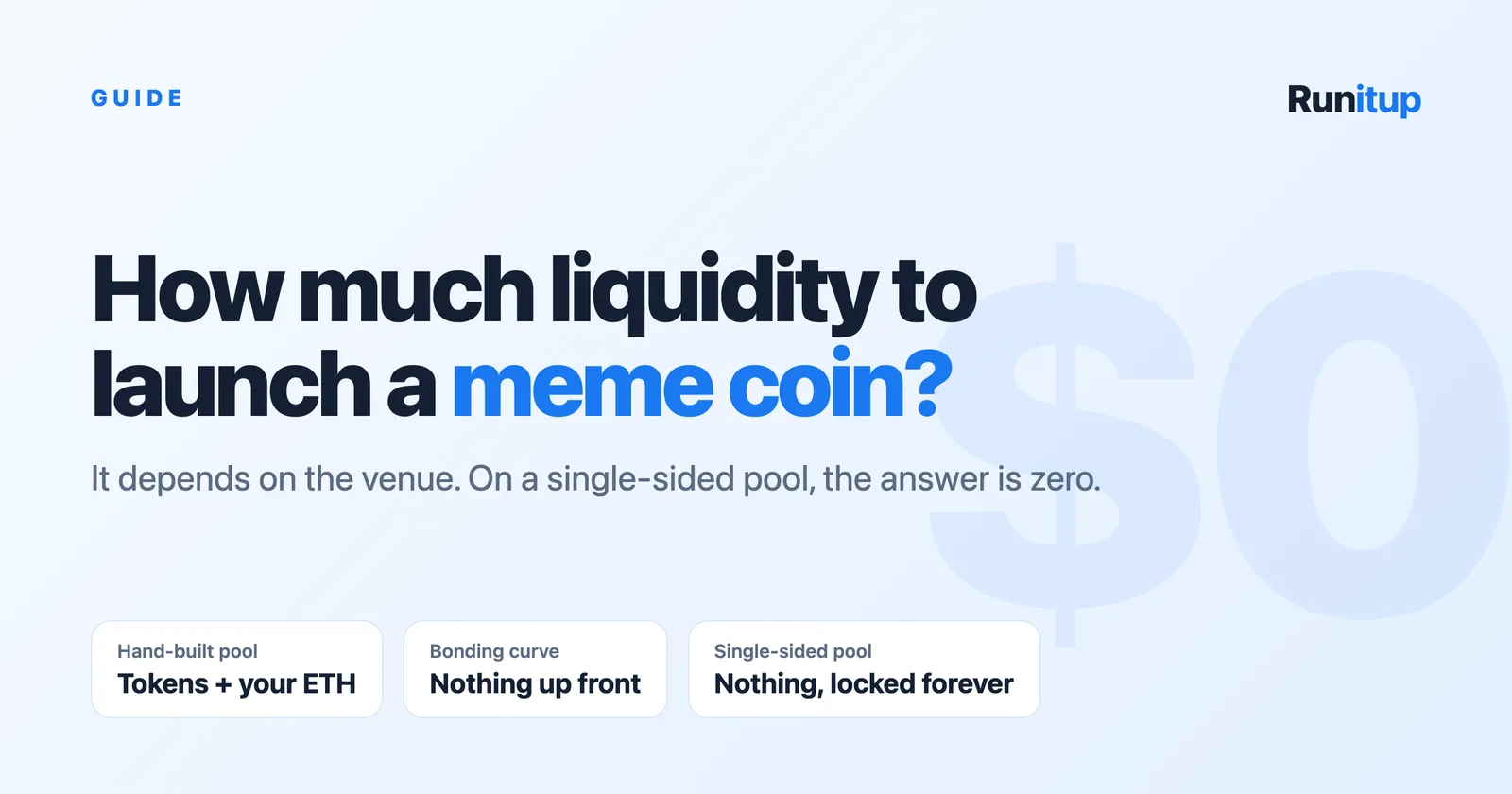
How much liquidity to launch a meme coin? The honest answer is that it depends on where you launch. On a pool you build yourself, it is whatever opening value you choose to put in. On a bonding curve, it is nothing. On a single-sided pool, like the one every Runitup coin opens on, it is also nothing. Meme coin liquidity is not one magic number, it is a property of the venue.
A lot of the advice ranking for this question tells you to bring hundreds or thousands of dollars of liquidity. That advice is right for one way of launching and wrong for the other two. This post explains what liquidity actually does for a new coin, how each venue handles it, with diagrams and real numbers, and the few cases where you would still want to add some.
One disclosure first: Runitup is our product. Every Runitup number below comes from our live config and docs on 27 October 2026, and every number about other venues comes from their own documentation.
What liquidity actually does for a meme coin
Meme coin liquidity is the pile of assets a trade happens against. For a new coin that usually means a pool holding your token on one side and ETH (or another asset) on the other.
It does three jobs:
- It sets the price. A pool prices your coin from the ratio between its two sides.
- It sets the depth. The more there is on the ETH side, the less each buy moves the price.
- It is the exit. When someone sells, the ETH they receive comes out of the pool.
People often mix up liquidity and market cap. They are different things. Market cap is the price times the supply. Liquidity is what is actually sitting in the pool to trade against. A coin can show a $50,000 market cap on a few hundred dollars of liquidity.
How much liquidity to launch a meme coin, by venue
Here is the short version, before the detail.
| Venue | What you deposit | Who sets the opening price | Where the liquidity ends up |
|---|---|---|---|
| Hand-built Uniswap pool | Your tokens plus ETH | You, through the ratio | Your LP position, withdrawable unless locked or burned |
| Bonding curve (pump.fun-style) | Nothing | The curve's formula | Moved to a DEX when the curve completes |
| Single-sided pool (Runitup) | Nothing | The platform: 1.5 ETH on ETH pairs | Locked permanently, no withdraw function |
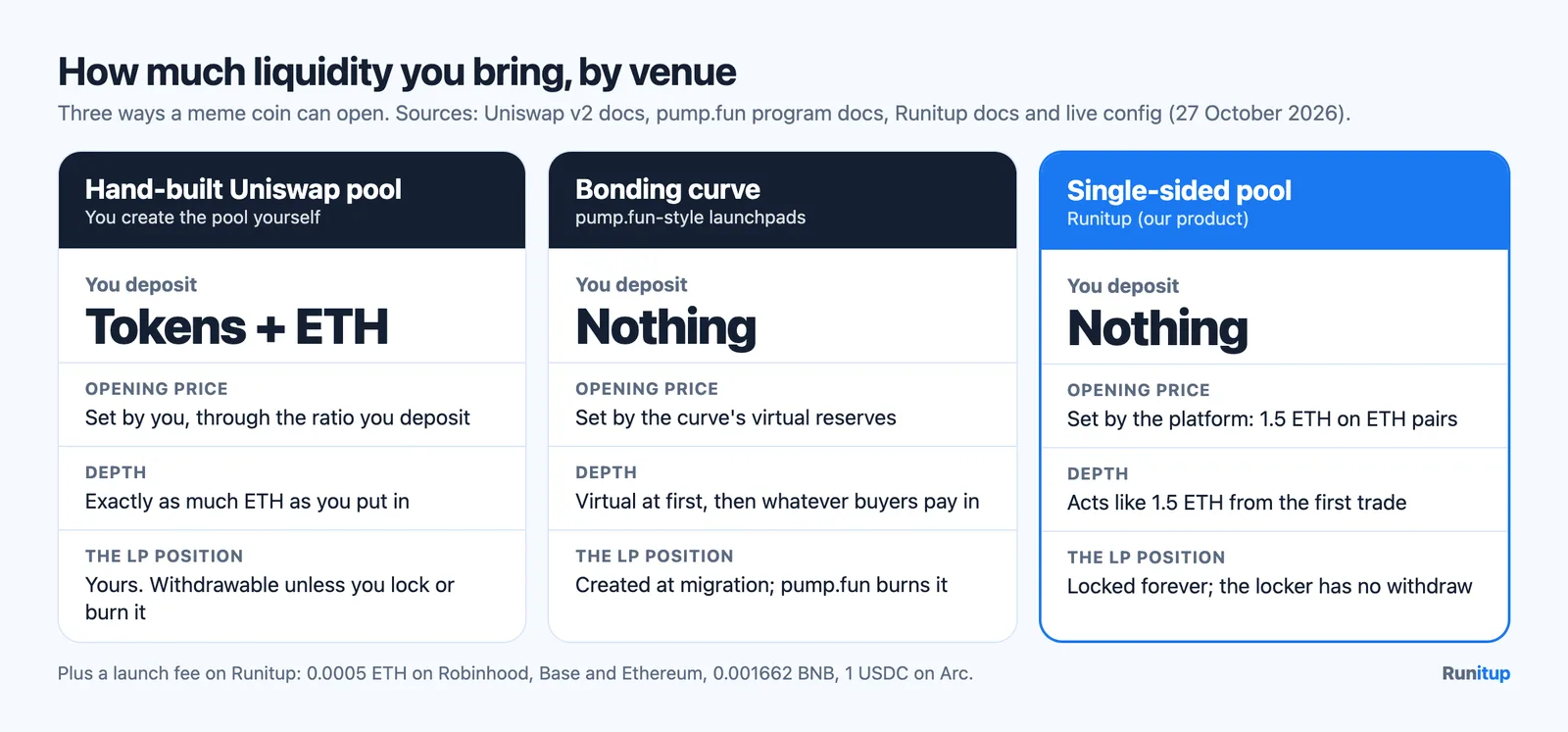
So the question "how much meme coin liquidity do I need" really means "which of these am I using?" The rest of this post takes them one at a time.
Meme coin liquidity on a hand-built Uniswap pool
This is the original way to launch, and it is where the big numbers in other guides come from.
You create the token, then create a pool for it on a decentralised exchange and deposit both sides yourself. Uniswap's own documentation describes it plainly: when a pool is created its balances are zero, so "someone must seed it with an initial deposit of each token. This first liquidity provider is the one who sets the initial price of the pool."
The ETH you add is your opening valuation
If you put your whole supply into the pool with some ETH, the arithmetic is short:
- price = ETH in the pool ÷ tokens in the pool
- market cap = price × total supply
With the whole supply in the pool, those two cancel, and the opening market cap equals the ETH you added. Put in 1 ETH and a billion tokens and your coin opens at a 1 ETH market cap, about $2,340 at today's ETH price. Put in 0.2 ETH and it opens at 0.2 ETH.
If you keep part of the supply back, the opening market cap is higher than the ETH you added, and buyers can see that you are holding the rest.
The ETH you add is also the depth
In a pool like this, buyers who spend some ETH get a share of the pool's tokens equal to:
share = ETH spent ÷ (ETH in the pool + ETH spent)
So a pool seeded with 0.5 ETH sells half its tokens for the first 0.5 ETH of buying. A pool seeded with 5 ETH sells only about 9% for the same 0.5 ETH. Thin liquidity means every buy, and every sell, swings the price hard.
The catch: the position belongs to you
When you deposit, you receive the LP position, the claim on everything in the pool. Whoever holds it can withdraw the liquidity. That is the classic rug pull: the creator pulls the pool and walks away with the ETH buyers paid in.
That is why buyers look for locked or burned liquidity on hand-built coins. If you launch this way, you have to arrange the lock yourself, and buyers have to trust that you did.
There is also a cost people forget. If the coin falls, sellers take ETH out of your pool and leave you holding the tokens they sold. The ETH you seeded does not stay ETH.
So how much meme coin liquidity should you add on a hand-built pool? There is no correct figure. The ETH you add decides your opening valuation and how much the price moves per trade. It should be an amount you are comfortable never seeing again.
Meme coin liquidity on a bonding curve
Bonding curve launchpads exist precisely so creators do not have to do any of the above.
Pump.fun's public program documentation describes its launches as "instantly tradeable on a bonding curve without having to seed liquidity." The trick is virtual reserves: the curve behaves as if it already holds a pile of SOL and tokens, so it can quote a price before anybody has paid anything. The docs list starting virtual reserves of 30 SOL against 1.073 billion tokens, with about 793 million real tokens available on the curve.
As people buy, real SOL accumulates in the curve. According to the same docs, "when the coin hits a certain market cap the liquidity from the bonding curve is migrated to PumpSwap", and the LP tokens from that pool "are then burnt."
So on a curve, the creator's meme coin liquidity is zero up front, and the buyers build it. The trade-off is that the coin has to complete the curve before it becomes an ordinary DEX pool, and most never do. Our bonding curve vs liquidity pool comparison covers how rarely that happens and what it means for a launch.
Meme coin liquidity on a single-sided pool
This is how every Runitup coin launches, on all five of our chains, and it is the reason the answer here is zero.
A normal pool needs both sides. A single-sided pool deposits one. Our single-sided pool docs put it in a table: at launch the pool receives 100% of your coin's supply, and nothing at all of ETH or whatever you paired against.
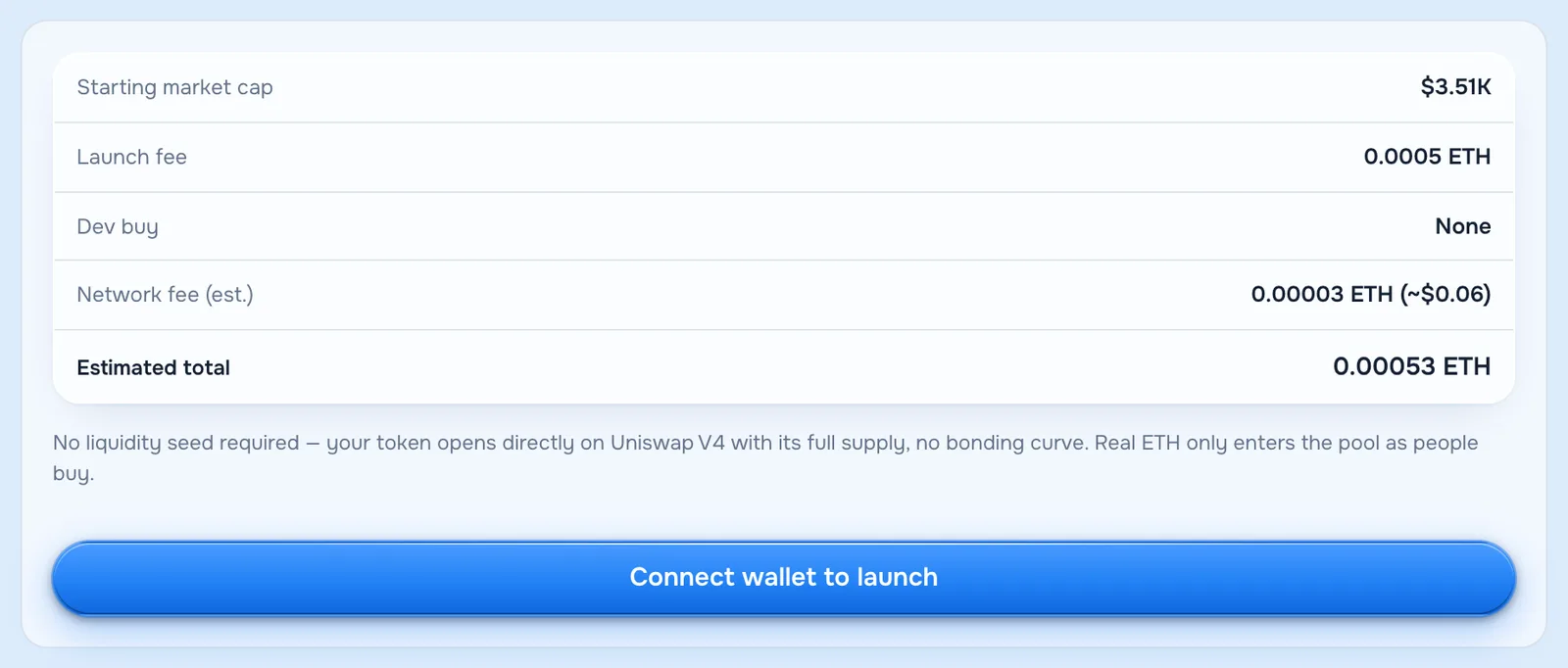
The launch form says the same thing above the button: "No liquidity seed required", and "Real ETH only enters the pool as people buy."
How a pool with no ETH can have a price
The position is opened across the full price range, with its lower edge pinned exactly at the starting price. Below that price it holds no ETH, which is fine, because there is none. Every buy walks the price up from that edge.
Because a pool with only one asset has no price of its own to discover, the platform sets the first one. Paired with ETH, a Runitup pool opens at a fixed 1.5 ETH market cap, about $3,510 today. Paired with anything else, it opens at a fixed $3,684 converted into that asset. On BNB Chain the native pairing opens at about 5.04 BNB, and on Arc at 2,700 USDC.
Here is what happens inside the pool as buyers arrive:
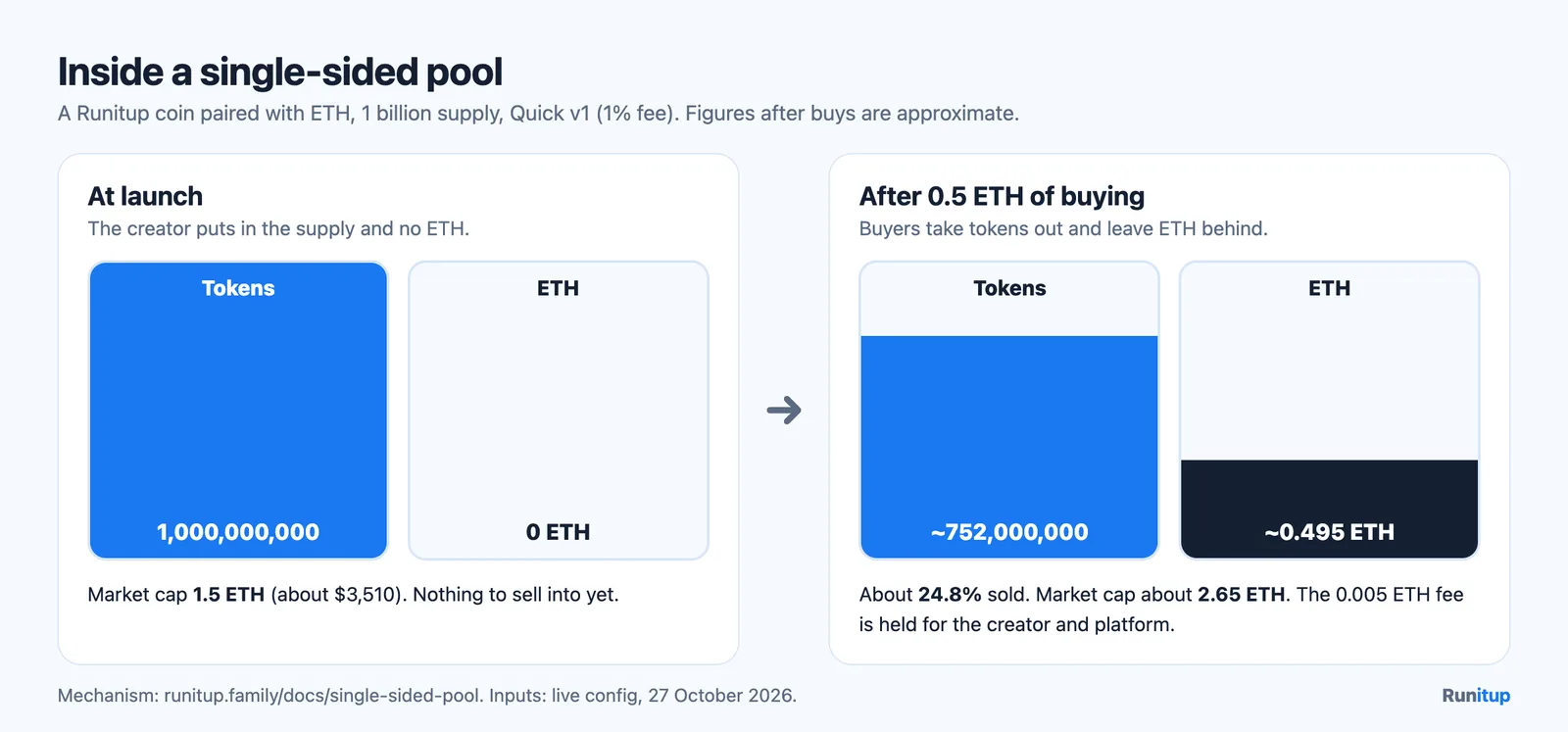
Worked through for a Quick launch on the v1 pool fee, with the default billion supply:
- At launch: 1,000,000,000 tokens, 0 ETH, market cap 1.5 ETH.
- Buyers spend 0.5 ETH. The 1% fee (0.005 ETH) is held for the creator and the platform, so 0.495 ETH goes into the pool.
- Share sold: 0.495 ÷ (1.5 + 0.495) = 24.8%, about 248 million tokens.
- Market cap after: (1.5 + 0.495)² ÷ 1.5 = 2.65 ETH.
These are approximate, because the exact result depends on the order of trades, but the shape is right.
The surprising part: you get the depth without the deposit
Look at the share formula again. It is the same one as the hand-built pool, with 1.5 ETH in place of "ETH in the pool."
That is not a coincidence. A full-range position that starts at the bottom edge of its range trades exactly like a hand-built pool seeded with the starting market cap in ETH. So the price moves on a Runitup launch the way it would on a hand-built pool holding 1.5 ETH, about $3,510 of meme coin liquidity, except nobody deposited it.
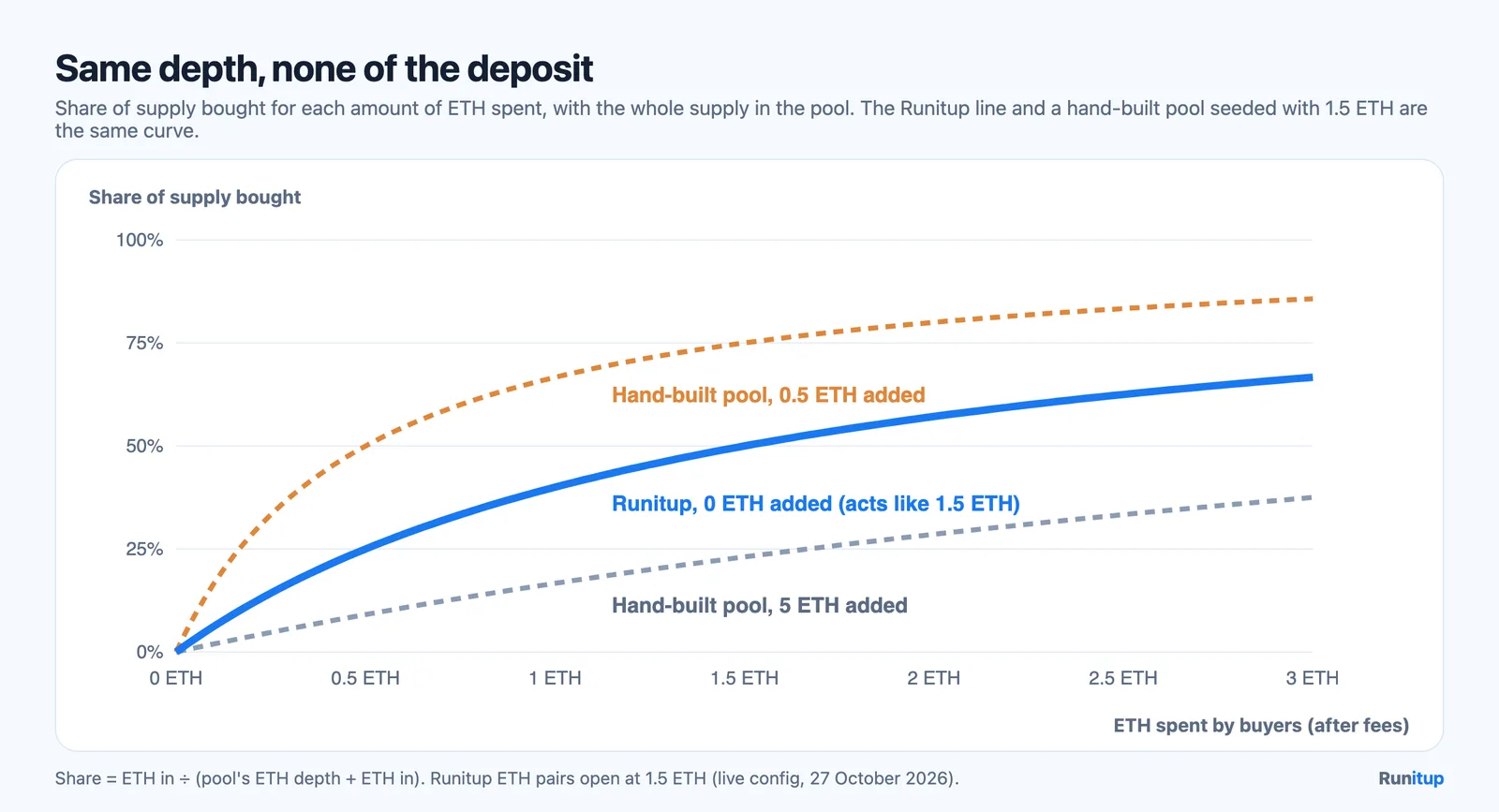
In practice: it takes about 0.62 ETH of buying, after fees, to double the price of a fresh Runitup coin paired with ETH. On a hand-built pool seeded with 0.5 ETH, about 0.21 ETH would do it.
What you do not get
Be clear about the difference, because it matters to sellers. On a hand-built pool, the 1.5 ETH would be real, sitting there for the first sellers. On a single-sided pool there is no ETH below the opening price. Sellers can only take out ETH that buyers have already put in. The depth going up is real; the floor underneath is not.
And it is locked
The LP position created at launch goes straight to a locker contract in the same transaction. On Robinhood Chain that is the locker at 0xf3E1bD55EE1A016203eBf078Ac16663dC12a9527. Our docs describe it as a contract "that has no withdraw function at all", not a timelock or a delay. Nobody, including the creator and us, can pull it.
The docs are also honest about the limit: locked liquidity "guarantees the pool cannot be pulled out from under you, so there is always something to sell into. It says nothing about what you will get." The price can still fall to almost nothing.
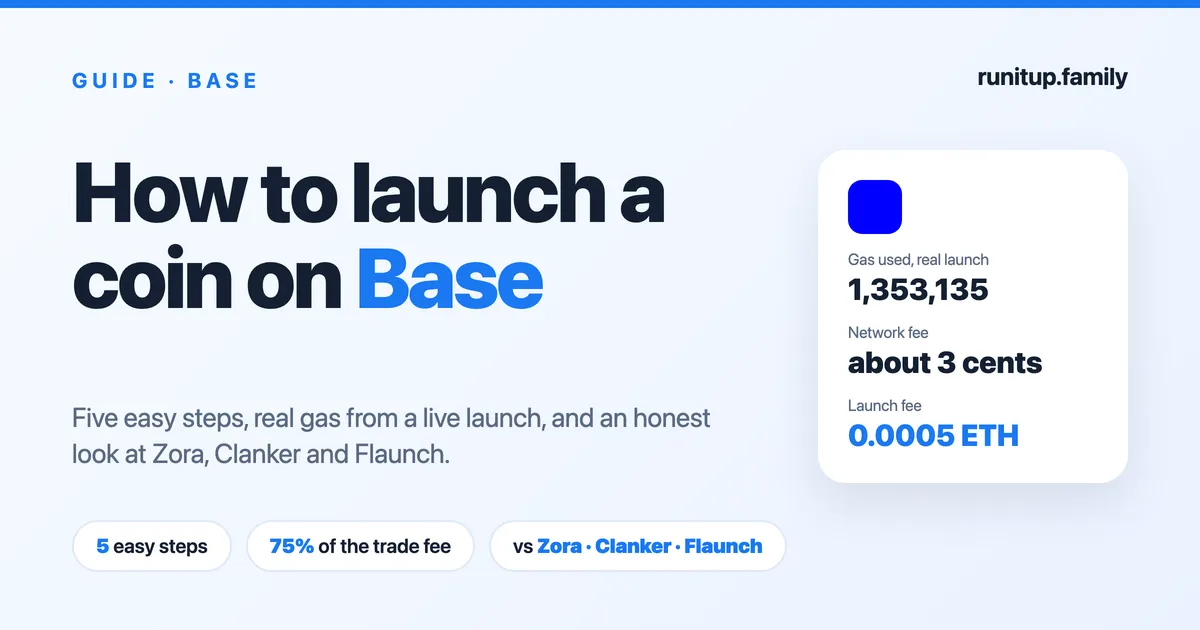
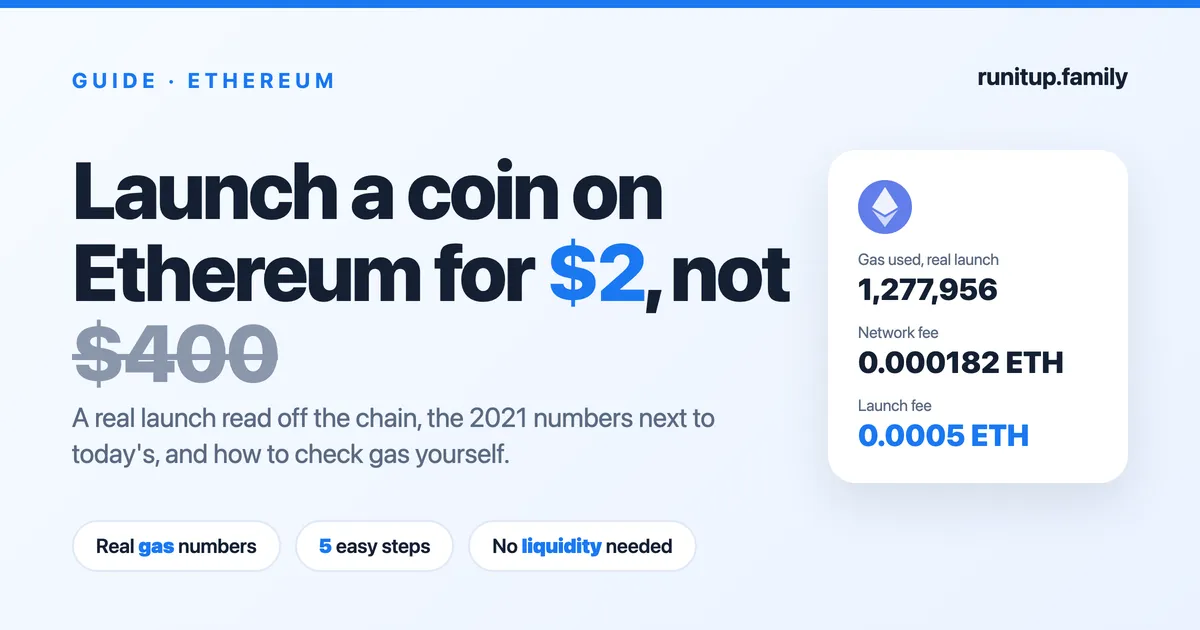
The whole cost of a launch is the launch fee plus gas: 0.0005 ETH (about $1.17) on Robinhood Chain, Base and Ethereum, 0.001662 BNB on BNB Chain, and 1 USDC on Arc.
When you would still add meme coin liquidity
Zero is the default, not a rule. Here is when adding some makes sense.
You are not launching on a single-sided pool. On a hand-built pool you have no choice. Decide your opening valuation, add that much ETH, and lock or burn the LP position so buyers do not have to take your word for it.
You want a bid under the price. Uniswap v3 and v4 let anyone provide one asset in a chosen price range. Placing ETH below the current price works like a standing buy order, giving sellers something to sell into on the way down. That position is yours, though, not locked. Buyers should not mistake it for the permanent liquidity, and you can withdraw it any time.
You want your share of trading fees from it. On a Runitup Quick launch with the v1 pool fee, the form spells it out: "Anyone who adds liquidity to the pool earns a share of the 1%." On v2 hook-fee and Advanced launches, the pool charges no fee of its own, so liquidity anyone adds earns none of it.
You want depth to grow by itself. On an Advanced launch, one place your tax can go is Liquidity. Our fee docs say that share is "partly swapped into the token, then added with the rest to the pool's locked position, which makes the pool deeper for good." It deepens the pool from trading, without you bringing cash. Advanced launches are open on Robinhood Chain, Base, BNB Chain and Ethereum.
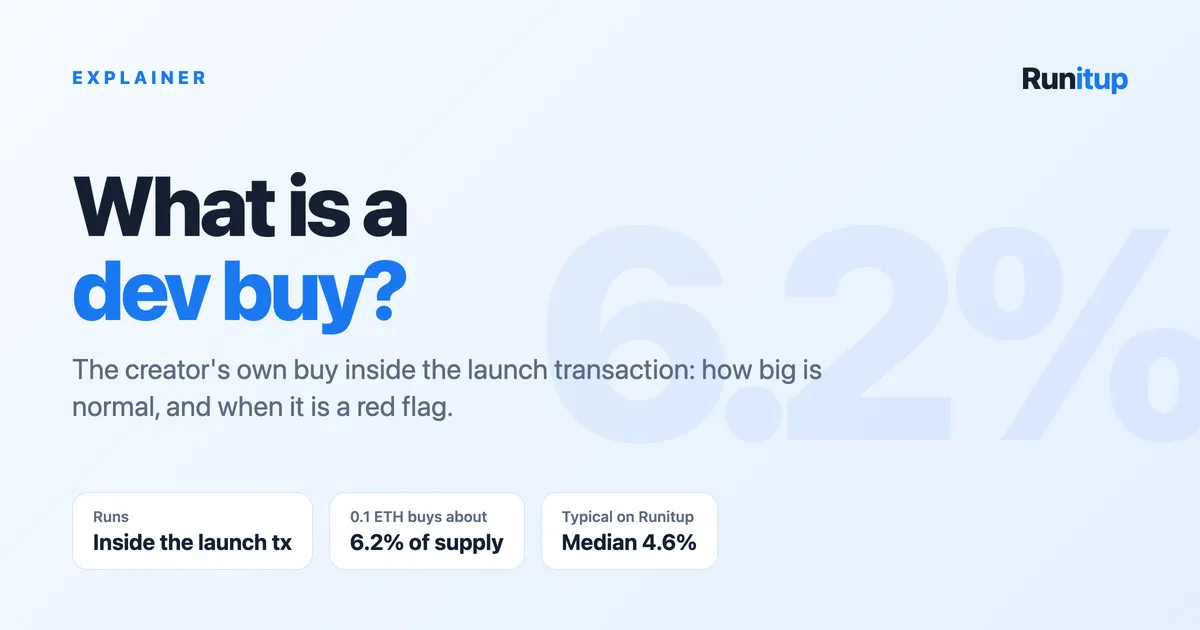
A dev buy, sort of. A dev buy puts ETH into the pool as part of the launch. Spend 0.1 ETH on a v1 pool and about 0.099 ETH stays in it for later sellers. Our guide to what a dev buy is has the full arithmetic, and the red flags buyers look for.
Bad reasons to add liquidity: to make the coin look bigger (on Runitup the opening market cap is fixed anyway), or because a guide said you need a certain dollar figure.
Mistakes people make with meme coin liquidity
Treating market cap as liquidity. A big market cap on a thin pool can disappear on a handful of sells. Check what is actually in the pool.
Calling unlocked liquidity locked. Extra liquidity you add yourself is withdrawable. Only the launch position sits in the locker.
Seeding a hand-built pool at the wrong ratio. Uniswap's docs warn that depositing at a ratio away from the market rate "immediately creates a profitable arbitrage opportunity." For a brand-new coin there is no market rate yet, but the ratio you pick is the price everyone gets.
Assuming more liquidity means safer. Locked liquidity means there is always something to sell into. It does not hold the price up.
Bringing liquidity you cannot afford to lose. On a hand-built pool, falling prices turn your ETH into your own tokens.
Meme coin liquidity questions people ask
Do I need liquidity to launch a meme coin on Runitup?
No. The pool opens with your whole supply and no ETH. You pay the launch fee and gas, plus a dev buy if you choose one.
Then where does the price come from?
From the platform-wide starting market cap: 1.5 ETH for ETH pairs, $3,684 converted for other pairs. It is the same for every launch and you cannot change it.
Can I add more liquidity after launch?
Yes, through the exchange's own interface. It will not be locked, it stays yours, and on a v1 pool it earns part of the 1% fee.
Can anyone remove the launch liquidity?
No. The position is held by a locker contract with no withdraw function, and the address is published so you can check it.
Is a single-sided pool the same as a bonding curve?
No. Both need nothing from the creator, but a curve is a separate contract that has to complete before the coin reaches a DEX. A single-sided pool is a real DEX pool from the first block, with no graduation step.
How much meme coin liquidity do buyers expect to see?
There is no standard. What careful buyers check is whether the launch liquidity is locked, who holds the supply, and what the dev does with their bag.
If you are planning a launch, the honest takeaway is to pick the venue first and let the liquidity question answer itself. If you would rather not risk your own ETH at all, a single-sided pool means you do not have to, and the launch form shows exactly what you will pay before you sign.