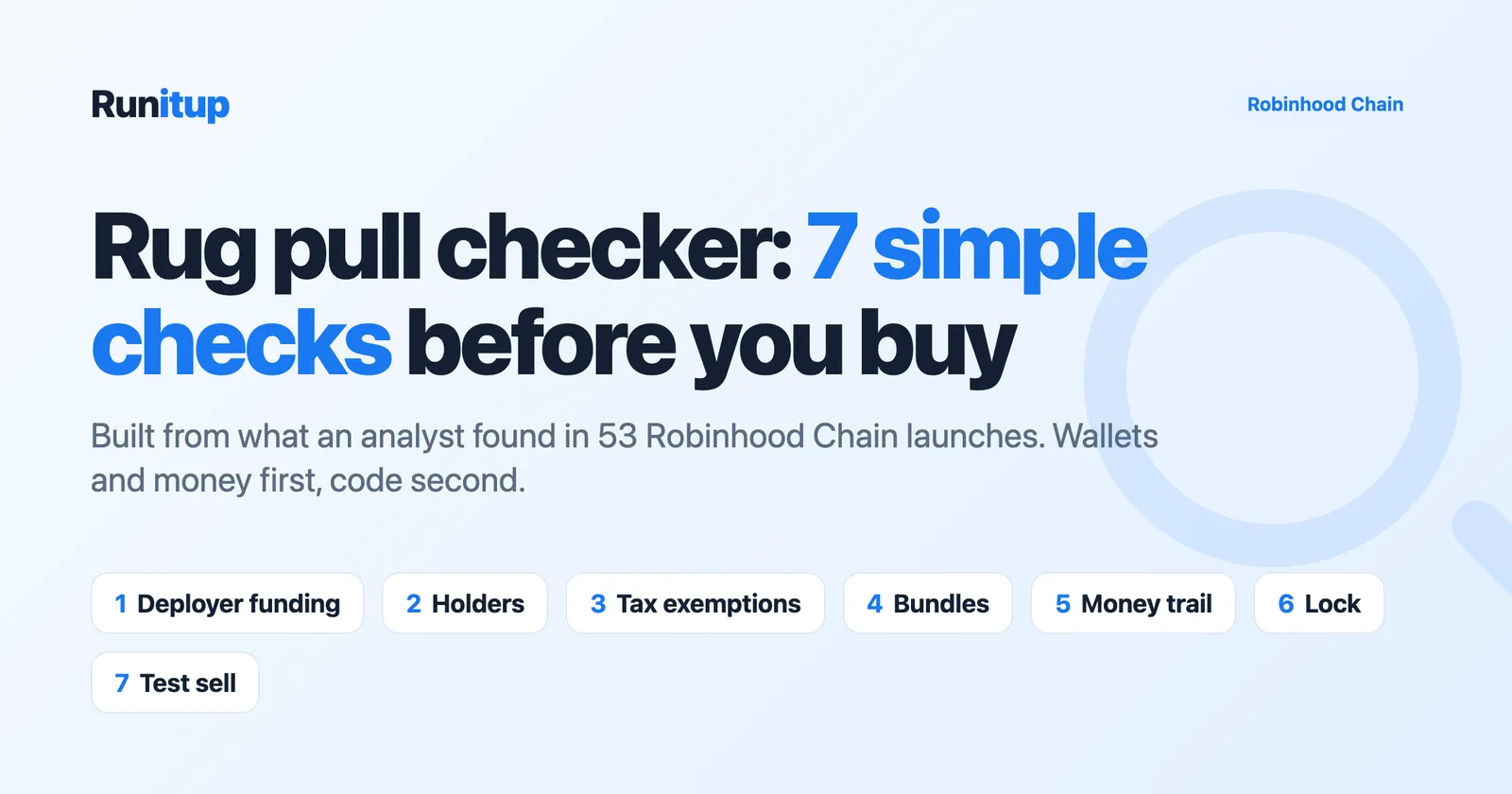
If you searched for a rug pull checker for Robinhood Chain, you probably found news about a rug ring and not much else. This guide is the missing part: a manual rug pull checker you can run on any Robinhood Chain token in about ten minutes, built from what an on-chain analyst found when tracing that ring.
No tool is perfect. The pattern in that report lives in wallets and money flows, which most automated scanners do not look at, so the checks below cover those as well as the contract. You only need a block explorer, a little patience, and a small amount of ETH for one test trade.
One thing up front: we run Runitup, a token launchpad on five chains, Robinhood Chain among them. It comes up once near the end, with steps to verify it yourself. Everything else applies to any token on any launchpad.
What happened on Robinhood Chain: the $18.4 million report
On 27 September 2026, The Block published a report on the analyst's findings. The analyst goes by Wazz. In The Block's words, "A single operation extracted at least $18.43 million from 53 memecoin launches on Robinhood Chain," between July 10 and Sept. 21.
Two details matter before anything else. The Block "confirmed how 10 of the launches listed in Wazz's thread were sniped," and it also says "The Block did not independently replicate the $18.43 million total." So the big number is the analyst's, and the reporter checked part of it.
The report names the launchpad most of the coins used. "Most of the tokens were launched through Pons V2, they said." It describes Pons as "the leading token launchpad on the recently launched Robinhood Chain." The report is about the creators and the wallets they used. It does not say the launchpad took part, and The Block noted it had reached out to Pons and Robinhood for comment.
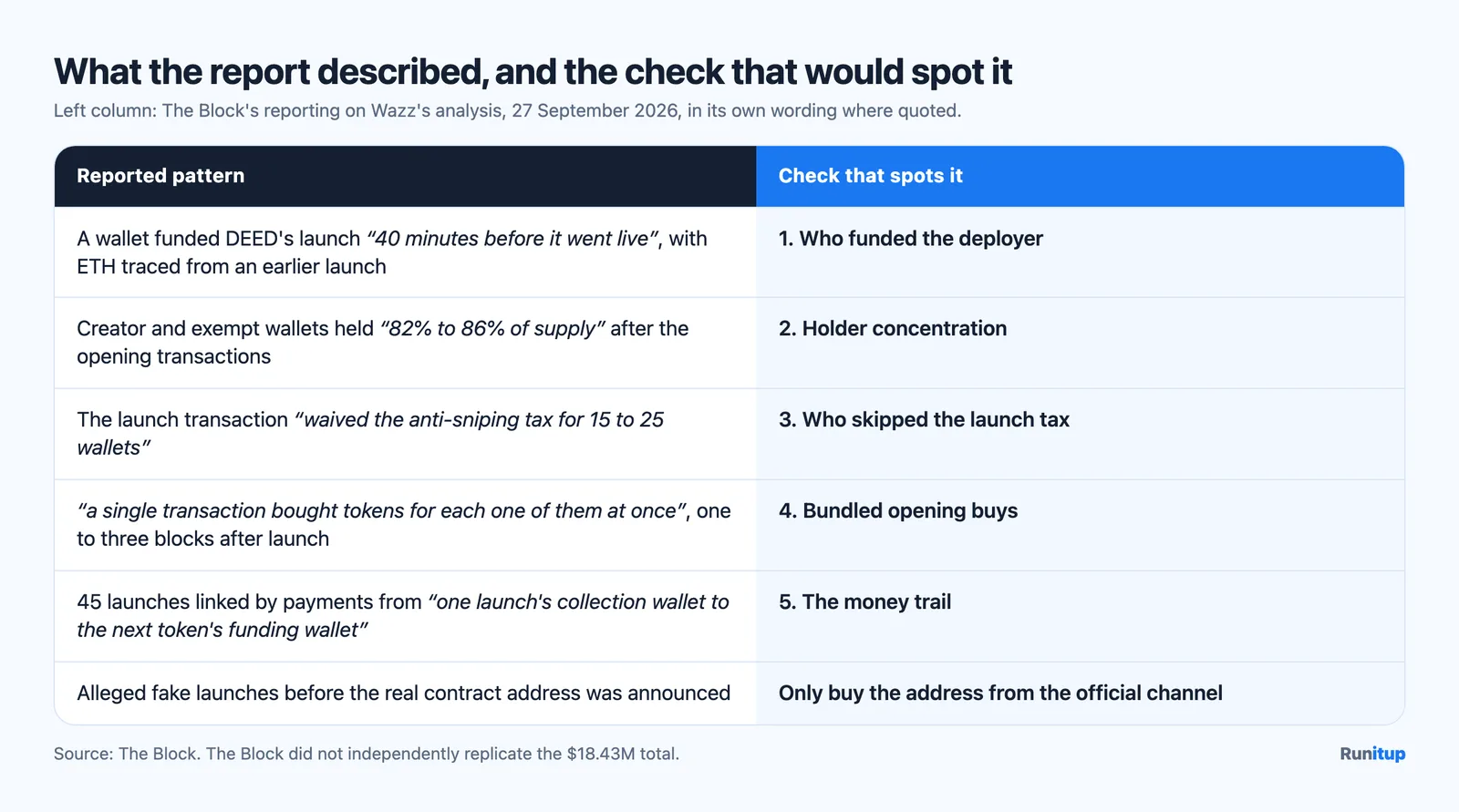
Here is the pattern The Block described, in its own wording where it matters:
- The launchpad "charges a 99% 'snipe tax' on buys in the first seconds after launch." Creators can waive it "for a team bundling its opening buys across several wallets," for up to 32 addresses.
- In the launches The Block looked at, "The creator's launch transaction waived the anti-sniping tax for 15 to 25 wallets," and "one to three blocks later, a single transaction bought tokens for each one of them at once."
- "The creator and the exempt wallets came out of the opening transactions holding 82% to 86% of supply."
- "All nine opening buys went through one unverified contract created on Aug. 28." Wazz told The Block it belongs to "a commercial bundling tool with many unrelated users."
- "Wazz linked 45 launches by tracing payments from one launch's collection wallet to the next token's funding wallet." Four more were linked through shared signing keys and four through a shared collector wallet.
- Wazz also "alleged the group ran fake launches of hyped tokens to take money from buyers" before announcing the real contract address.
Read that list again and notice what is missing: a malicious contract. The report does not describe a hidden mint function or a honeypot. It describes a handful of related wallets holding most of the supply from the first seconds, selling into the coin's own pool. In DEED's case, The Block found the wallets "started selling the token one second after launch."
Why a rug pull checker app alone misses this
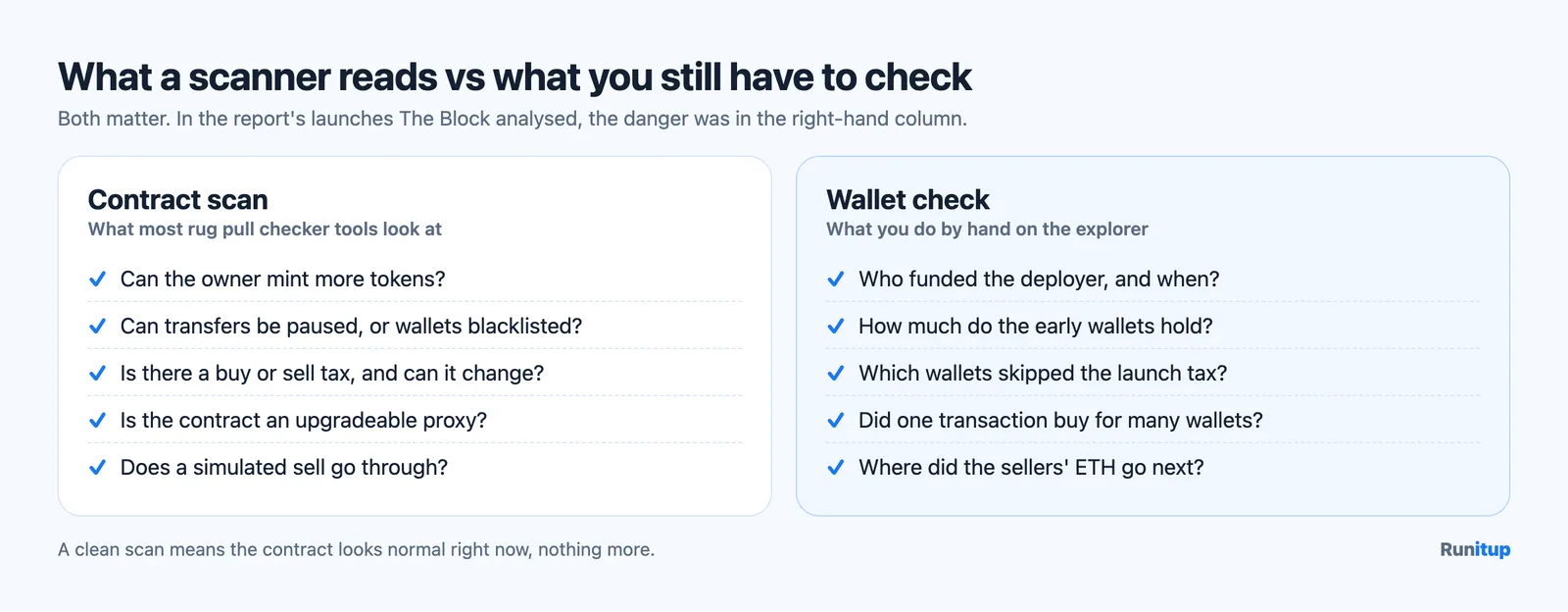
Most automated scanners read the token contract. They ask: can the owner mint, pause, blacklist, change the tax, or block sells? Those are good questions, and you should still ask them. But every one of them can come back clean on a coin where three wallets you have never heard of hold 85% of the supply.
That is why this rug pull checker is mostly about people and money, not code. A contract scan tells you what the token can do to you. A wallet check tells you who is about to sell.
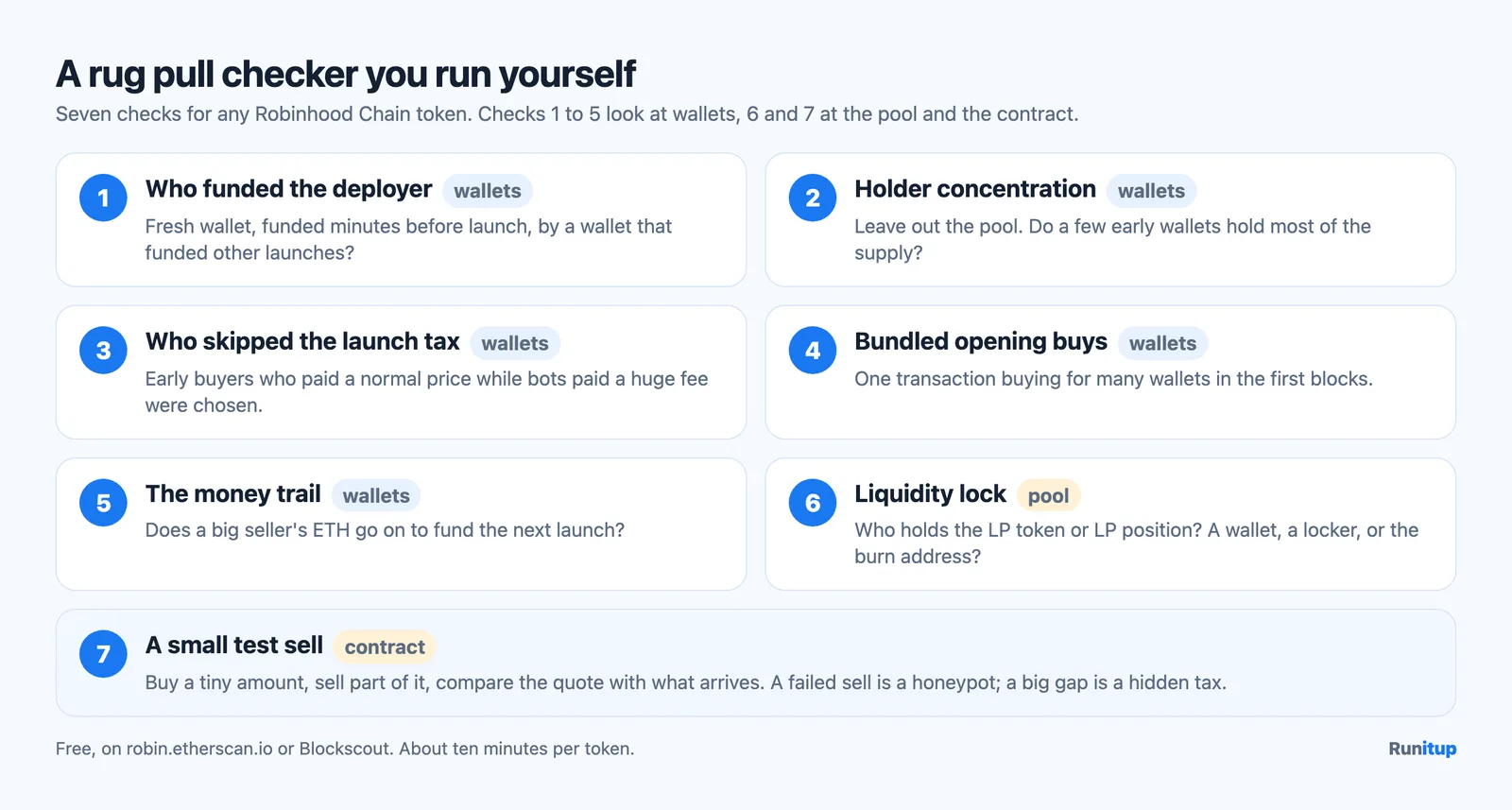
A manual rug pull checker for Robinhood Chain tokens
You can do all seven checks on robin.etherscan.io, the Etherscan explorer for Robinhood Chain. Blockscout (robinhoodchain.blockscout.com) shows the same chain data if you prefer it. Paste the token's contract address in the search bar and keep that tab open.
A quick word on jargon. The deployer is the wallet that created the token. A block is one batch of transactions; on Robinhood Chain one arrives roughly every tenth of a second, so "one to three blocks" means well under a second. Supply is the total number of tokens that exist.
1. Check who funded the deployer
Open the token page, find the creator address (on the contract's page, Etherscan lists the wallet that created it), and click through to that wallet. Sort its transactions oldest first and look at the very first incoming ETH.
What you want to see: a wallet with some history, funded from an exchange or from a wallet that has done normal things for weeks.
What should worry you: a brand new wallet funded minutes before the launch by another fresh wallet. In the DEED case, The Block traced ETH from an earlier launch to "the wallet that funded another launch, DEED, 40 minutes before it went live." If the funding wallet also funded other launches, open those coins and see how they ended.
2. Look at holder concentration right after launch
Open the token's Holders tab. Ignore the pool itself (it will usually be the biggest holder, and that is the liquidity, not a whale). Then add up the next ten wallets.
If a few wallets that bought in the first seconds hold most of the supply, they can sell into every buyer who arrives later. The report's number is your benchmark of what bad looks like: creator plus exempt wallets holding 82% to 86% of supply after the opening transactions.
There is no single safe percentage. But if the top ten non-pool wallets hold more than half, and they all bought at the very start, slow down.
3. Look for wallets that skipped the launch tax
Many launchpads charge a heavy fee on the first seconds of trading to stop bots. If some early buyers paid that fee and a group of others did not, that group was chosen.
On the explorer, open the token's first trades and compare what each early buyer paid against what they received. A wallet that bought in the first second at a normal price, while bots around it paid a huge fee, was very likely exempted by the launch transaction. In the launches The Block analysed, it was 15 to 25 wallets each.
4. Spot bundled opening buys
Look at the first few blocks after the pool opened. Are there dozens of buys, each to a different wallet, all coming from one transaction? On Etherscan that shows up as one transaction hash with many token transfers inside it.
A bundled buy is not proof of a scam on its own. Teams use bundlers for legitimate reasons too, and Wazz said the contract in this case had "many unrelated users." But a bundle that ends up holding most of the supply, combined with checks 1 to 3, is the exact pattern in the report.
5. Follow the money to the next launch
This one takes longer, so save it for coins you are serious about. Pick one of the big early wallets and look at where its ETH went after it sold. If the ETH moved to a fresh wallet that then funded a new token launch, you may be looking at a repeat operation. This is how the analyst linked 45 of the 53 launches.
You do not need to prove anything. You only need to decide whether you want to be the exit liquidity for a wallet group with that history.
6. Check the liquidity lock on robin.etherscan.io
Liquidity is the ETH and tokens sitting in the pool that let people sell. If the dev can withdraw it, they can empty the pool and your tokens become unsellable. That is the classic rug pull.
How you check depends on the type of pool:
- Older-style pools (V2): the claim on the liquidity is an LP token. Open the LP token's Holders tab. Locked looks like most of it sitting at a dead address or at a known locker contract with an unlock date you can read. Not locked looks like most of it in a normal wallet.
- Uniswap V3 and V4 pools: the claim is an NFT position. Open the launch transaction and look at its NFT transfers to see where the position went. If it went to the dev's wallet, it is not locked. If it went to a locker contract, open that contract and confirm its source is verified and that it has no withdraw or unlock function, or note the unlock date.
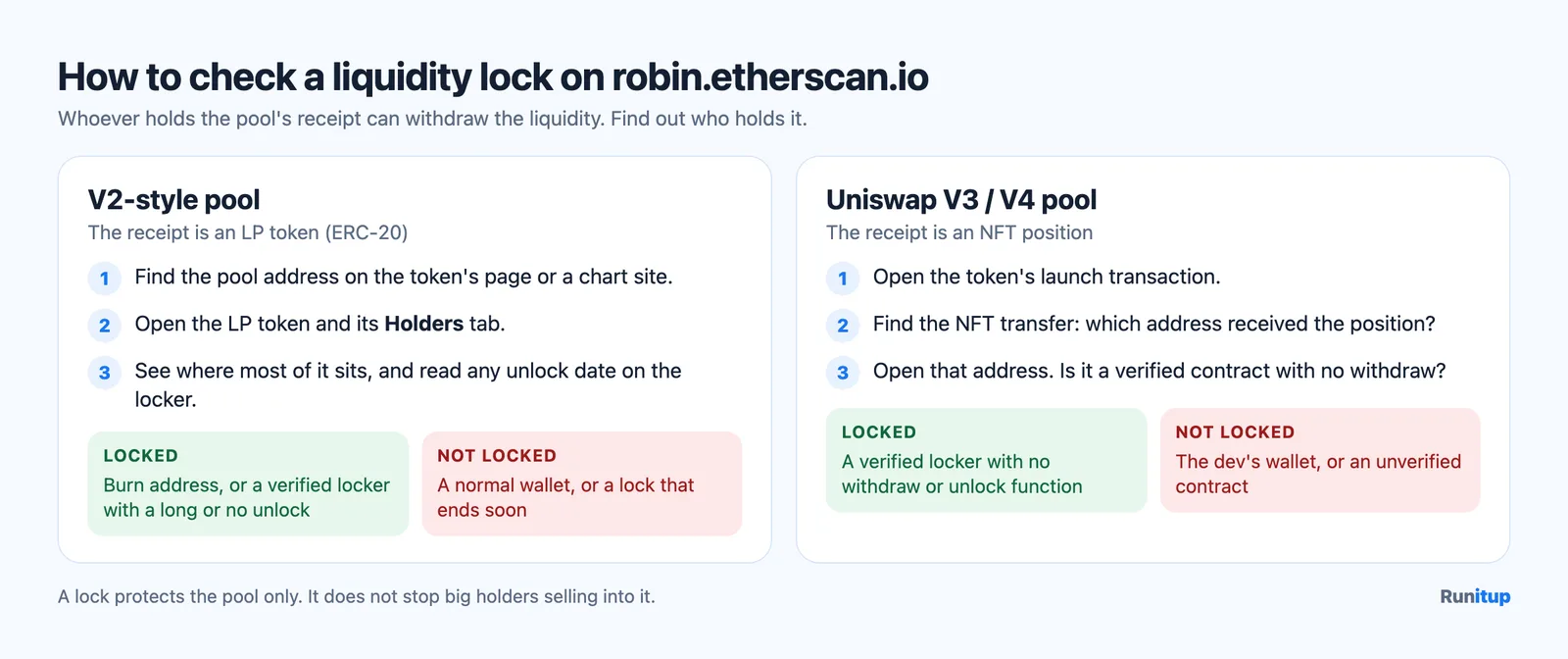
A lock only protects the pool. It does nothing about step 2. A coin can have locked liquidity and still be drained by insiders selling 85% of the supply into it.
7. Make a small test sell
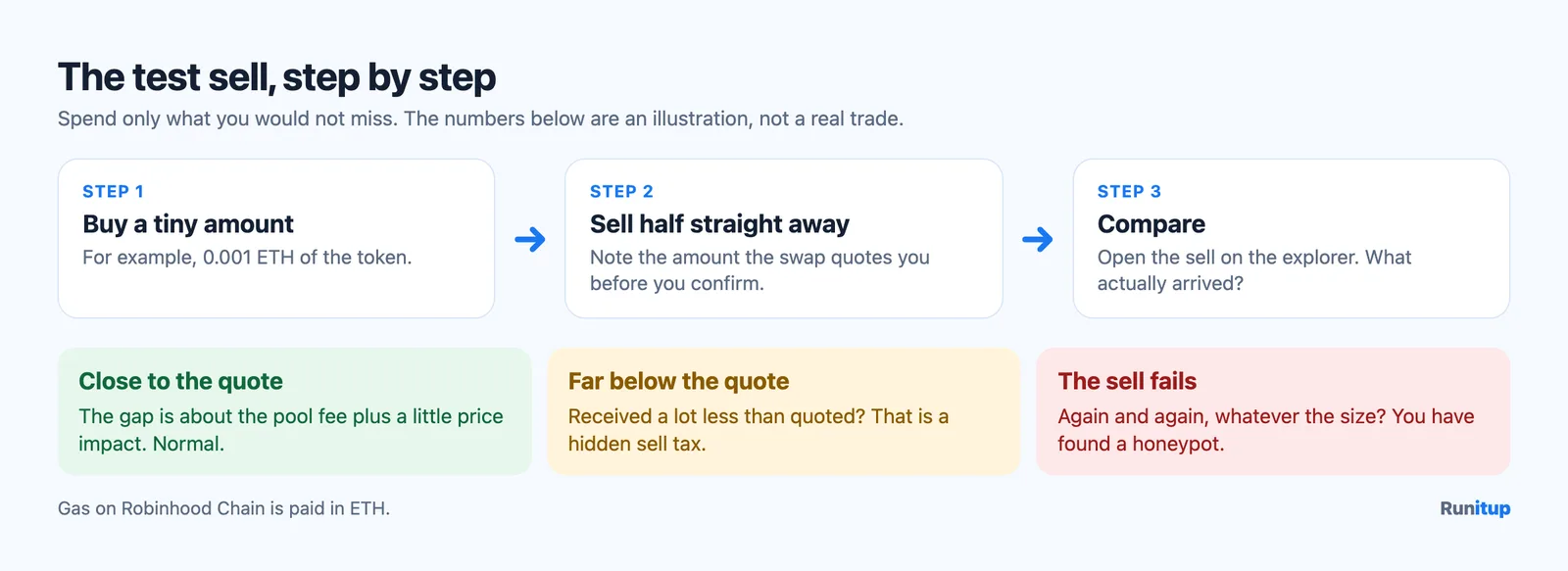
Buy a tiny amount, the kind of money you would not miss. Then immediately sell part of it.
Compare what the swap quoted you against what actually arrived. The gap should be roughly the pool fee plus a little price impact. A gap far bigger than that is a hidden sell tax. A sell that fails, again and again, is a honeypot, and you have just learned it for the price of a coffee instead of your whole bag.
Honeypot red flags to look for
A honeypot is a token you can buy but cannot sell. These are the signs, in rough order of how fast you can check them:
- Buys but no sells. Open the token's trades. Lots of buys and almost no successful sells is the loudest signal there is.
- Failed sell transactions. Failed transactions on the token or pool, all of them sells, usually mean the contract is refusing them.
- Unverified source code. If the Contract tab has no green check and only bytecode, nobody can read what the token does. Treat that as a "no" unless you have a very good reason.
- Owner powers. On a verified contract, open Read and Write Contract. Functions like
setTax,setFee,blacklist,pause,mintorsetMaxTxheld by an owner mean someone can change the rules after you buy. - Upgradeable proxy. If the explorer says the contract is a proxy, the code you read today can be swapped tomorrow.
- A sell tax that differs from the buy tax. A 2% buy and a 40% sell is a trap with extra steps.
Relay Protocol warned on 9 July that buyers on the chain were being caught by honeypot tokens, and it gave the same advice as this list: check the address and test with a small swap first. These are not theoretical.
Rug pull checker tools that cover Robinhood Chain
Tools speed this up. None of them replaces checks 1 to 5, because most read contracts and simulate trades rather than tracing who holds the supply. Here are the ones that came up when we searched for this topic, listed neutrally. We have no relationship with any of them.
| Tool | What it is | Notes |
|---|---|---|
| TrustSwap Robinhood Chain hub | A hub page with a honeypot checker, guides and live chain data | TrustSwap's honeypot checker is part of it. TrustSwap also sells token creation and locking. |
| Blockaid | A security company whose token scanning covers Robinhood Chain | Built for wallets and apps to integrate, not a paste-an-address page. Its own site says it flags "impersonation tokens, rugpulls, honeypots, and spam." |
| Bugglo | A read-only contract inspector for chain 4663 | We found its self-published whitepaper, but its site did not load when we checked on 27 October 2026. |
| Hood Trade | Described in a post on KuCoin's news feed as a buy and sell simulator for the chain | We could not find an official site, so we could not confirm it exists today. |
A clean result from any of these means "the contract looks normal right now." It does not mean "the people holding the supply will not sell."
How to verify a Runitup coin yourself
Every coin launched on Runitup has its liquidity locked permanently, the moment it launches, and a Quick launch token is a plain ERC-20 with no owner, no mint and no pause. You should not take that on trust, so here is how to check a Quick launch on Robinhood Chain on robin.etherscan.io in two reads. Advanced launches and the other chains use their own contracts, all listed on our contracts page.
- On the coin's Runitup page, press the Pool id chip to copy it.
- Open the liquidity locker
0xf3E1bD55EE1A016203eBf078Ac16663dC12a9527on robin.etherscan.io, go to Read Contract, and callpositionOfwith that pool id. You get a position number. - Open the position manager
0xe38A007e42d7aAb09b7ad5fE083293C2Cc3DE45b, go to Read Contract, and callownerOfwith that number.
The answer is the locker's own address. We ran it today on Velnora, one of the examples in our docs: positionOf returned 34 and ownerOf(34) returned the locker. Coins launched before 11 September 2026 sit in an older locker, 0x35Ff7595dB6D0F8680Fe554F3Cd2Aa9933E76C2E, so if you get 0, ask that one instead. The liquidity lock docs explain why there are two, and the security page goes through every scanner check for the token itself.
Be clear about what that proves and what it does not. A lock means the pool cannot be pulled. It says nothing about who bought the supply. Checks 1 to 5 still apply to a Runitup coin exactly as they do to any other.
Rug pull checker FAQ
Is there a rug pull checker that works on Robinhood Chain?
Yes, a few tools cover the chain, listed in the table above. The honest caveat: most of them check the contract, and the pattern in The Block's report was in the wallets. Use a tool for the contract, and the manual checks for the wallets.
Does locked liquidity mean a coin is safe?
No. It means nobody can withdraw the pool. Insiders can still sell a large bag into it, and the price can still fall to almost nothing. Locked liquidity rules out one kind of rug, not all of them.
What is a snipe tax, and why does an exemption matter?
A snipe tax is a high fee on the first seconds of trading, meant to make bots pay. An exemption lets chosen wallets skip it. That can be harmless, a team buying its own allocation openly. It becomes a warning when the exempt wallets end up with most of the supply and start selling.
How much should I spend on a test sell?
As little as the pool lets you trade. The point is to learn whether a sell goes through and what it costs, not to make money. On Robinhood Chain, gas is paid in ETH and is usually a small part of a tiny trade.
Can I check a token before it launches?
Partly. You can check the deployer wallet and who funded it as soon as you know the address. Be careful with "contract address coming soon" hype: the report alleges fake launches went out before the real address was announced. Only buy the address the project posts in its own official channel.
Run the checks every time
None of this takes long once you have done it twice. Funding, holders, exemptions, bundles, money trail, lock, test sell: seven checks, and most bad coins fail one of the first three.
If you hold a coin and want to understand burns too, for example when a team says it "burned the LP," read our guide to the Robinhood Chain burn address. It shows which address real burns go to on this chain and how to prove a burn on the explorer.