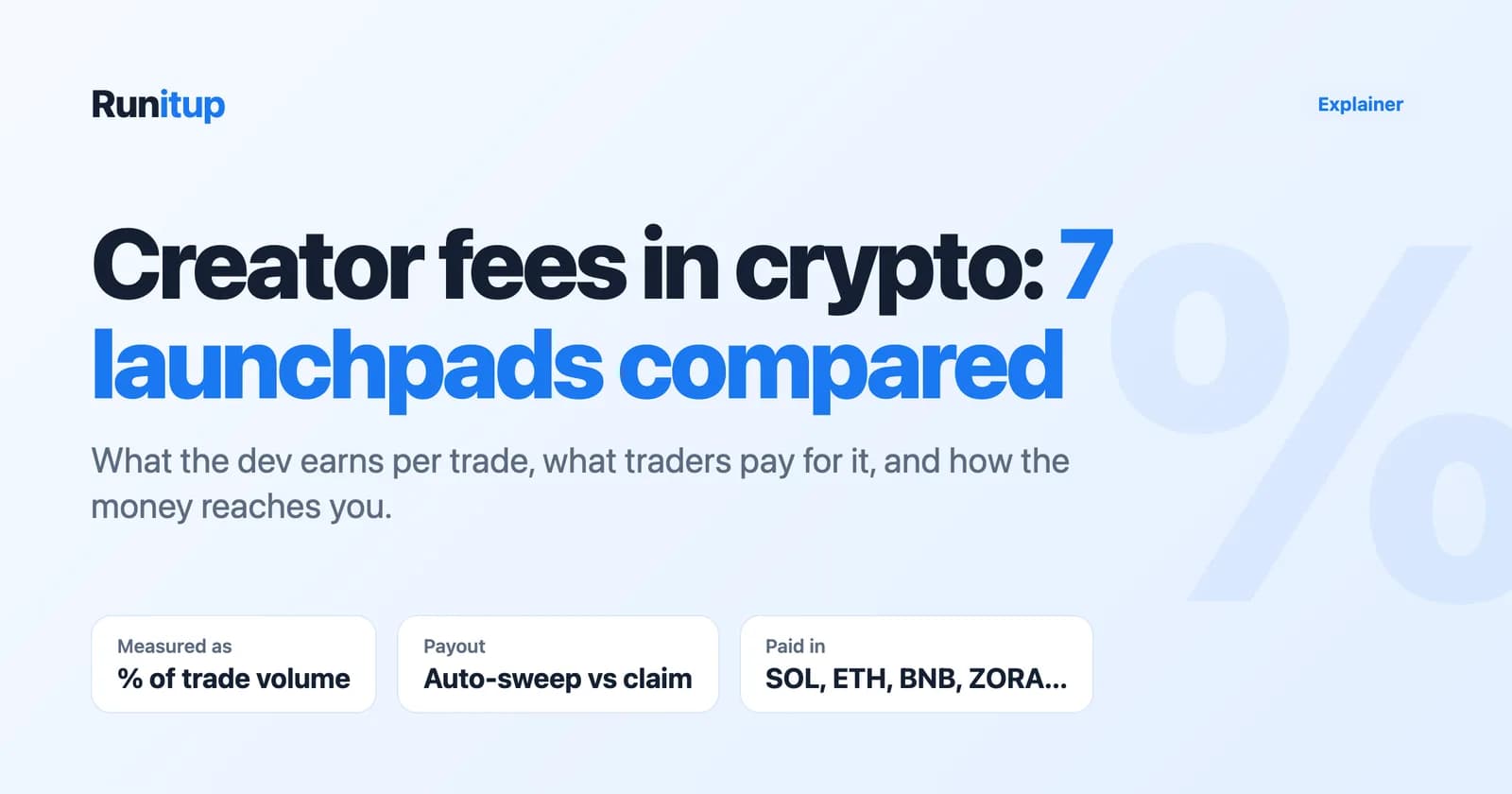
What are creator fees in crypto? They're the slice of every trade on a coin that goes to the person who launched it. Every memecoin launchpad now offers creator fees in some form, but the numbers, the payout method and even the currency you're paid in differ a lot from one platform to the next.
This guide explains how creator fees work, then compares seven launchpads side by side, using each platform's own docs as checked on 27 October 2026. Runitup is one of the seven, and it's our product, so we've kept every rival's number to what their docs actually say. Where we couldn't confirm a number, we say so.
We also cover the question many new devs are really asking: how do memecoin devs make money at all?
What are creator fees in crypto?
When someone buys or sells a coin, they pay a small trading fee, usually around 1%. That fee gets split. Part goes to the launchpad (the platform). Part may go back into the pool as liquidity. And part goes to the coin's creator. That last part is the creator fee.
A few things make creator fees different from other ways a dev can earn:
- They're paid by the trading, not by the price. A coin that trades sideways all day earns its creator more than one that doubles on two trades.
- They keep coming. As long as the coin trades, the creator keeps earning. There's no need to sell any of your own coin.
- The creator doesn't set the trading fee on most launchpads. The platform does. You choose the launchpad, and with it the deal.
You'll also hear "creator rewards", "creator earnings" or "dev fees". They mean the same thing: the creator's share of the trading fee.
How creator fees work: a worked example
Here's the simplest version. Say a launchpad charges a 1% fee on every trade and gives the creator 75% of it.
Someone buys $1,000 of your coin. The fee is $10. You get $7.50, the platform gets $2.50.
Now scale it up. At $100,000 of lifetime trading volume, you've earned $750. At $1 million, $7,500. That's why creators care about volume more than price.
The two numbers that matter are:
- What traders pay (the total fee on each trade).
- What the creator gets (the creator's share of it, as a % of the trade).
The rest of this guide measures every launchpad the same way: as a percentage of each trade. That's the only fair way to compare a "50% of the fee" deal with a "75% of the fee" deal when the fees themselves are different sizes.
Creator fees compared: 7 launchpads
Here are the standard settings on seven launchpads, taken from each one's own docs today.
| Launchpad | Trader pays | Creator gets | How it's paid | Paid in |
|---|---|---|---|---|
| pump.fun (Solana) | 1.25% on the curve | 0.30% on the curve, 0.05% to 0.95% after graduation | Claim | SOL or USDC |
| Bags (Solana, default) | 2% | 1% before graduation, 0.75% after | Claim | SOL |
| Bags (Robinhood Chain) | 2% | 1% | Claim | WETH |
| Clanker (docs example) | 1.2% | 1% | Claim, anyone can trigger | Pool assets |
| Zora (creator and content coins) | 1% | 0.5% | Automatic, every swap | ZORA |
| Pons V1 (Robinhood Chain) | 1% | 0.70% | Claim, automation may sweep | Your coin and WETH |
| Four.meme (BNB Chain) | 1%, plus an optional tax | Not stated | Not stated | Pair asset, for tax |
| Runitup Quick (5 chains) | 1% | 0.75% | Automatic, about hourly | Pair asset (and your coin on v1) |
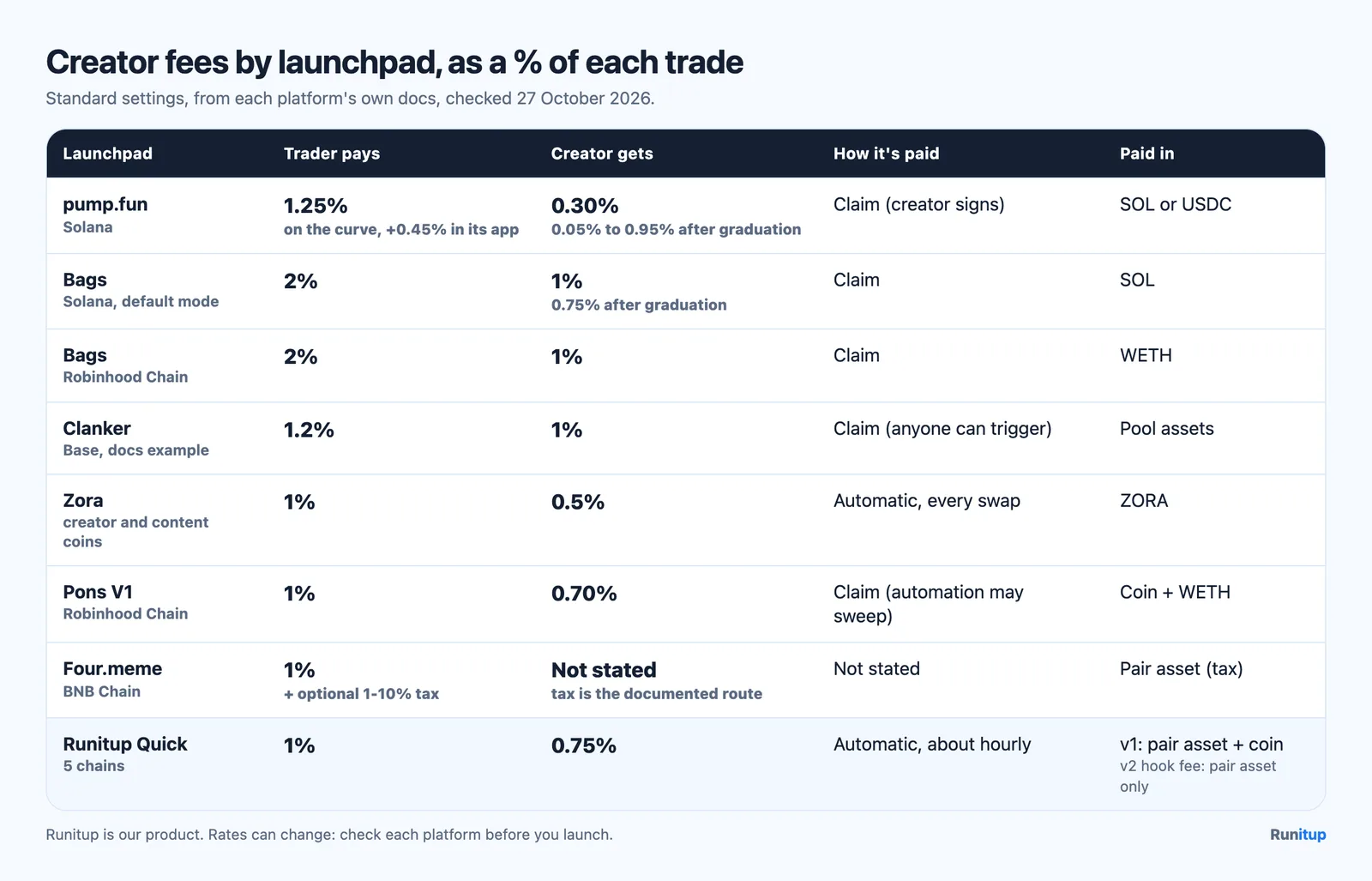
A few notes on each, so you know exactly what's behind the numbers:
- pump.fun. Its fees page splits a 1.25% curve fee into 0.30% creator and 0.95% protocol. After graduation the creator's cut follows market cap: 0.30% below 420 SOL, then 0.95%, falling step by step to 0.05% for the biggest coins. Since 17 October 2026, trades in pump.fun's own app also pay a 0.45% platform fee. Fees collect in a creator vault, and the creator signs a transaction to collect them.
- Bags. On Solana, the default mode charges 2%. Before graduation 1% goes to the creator side; after graduation 0.75% does, because 0.5% is put back into liquidity. On newer setups a separate deployer share (25% of the creator side) comes out of that. On Robinhood Chain it's a flat 2% with 1% to the creator, paid in WETH. Both are claimed.
- Clanker. Its docs give the example of a 1% creator fee with Clanker taking 20% on top, so traders pay 1.2%. Higher creator settings cost traders more: the same table shows 2% becoming 2.4% and 3% becoming 3.6%. Rewards are claimed on the token's admin page, and anyone can press claim on the creator's behalf.
- Zora. Creator and content coins charge 1%. The creator gets 50% of it (0.5% of the trade), paid automatically on every swap and converted to ZORA. Its coin rewards docs show the full split.
- Pons. Pons V1 docs say current launches use a 1% pool fee split 70% creator, 30% protocol, which is 0.70% of the trade. You claim from the Pons interface, and if you don't, Pons automation may claim it for you. Pons V2 docs describe the split as set per launch and don't publish one fixed number, so we've used V1.
- Four.meme. Its docs say the platform takes a 1% trading fee but don't state a creator share for a classic launch. The documented route is a Tax Token, where the creator picks a 1%, 3%, 5% or 10% tax. We compare it in detail in our four meme alternative guide.
- Runitup. A Quick launch charges 1% and pays the creator 75% of it, 0.75% of the trade. The rest goes to the platform, with no third cut. (On the v1 fee model, 0.5% of the pair-asset side first repays whoever pays the gas to collect, so that side comes to 74.625%.) The full rules are on our fees and tax page.
The catch: a bigger creator cut often means traders pay more
It's tempting to sort the table by "creator gets" and pick the top. But look at the column next to it.
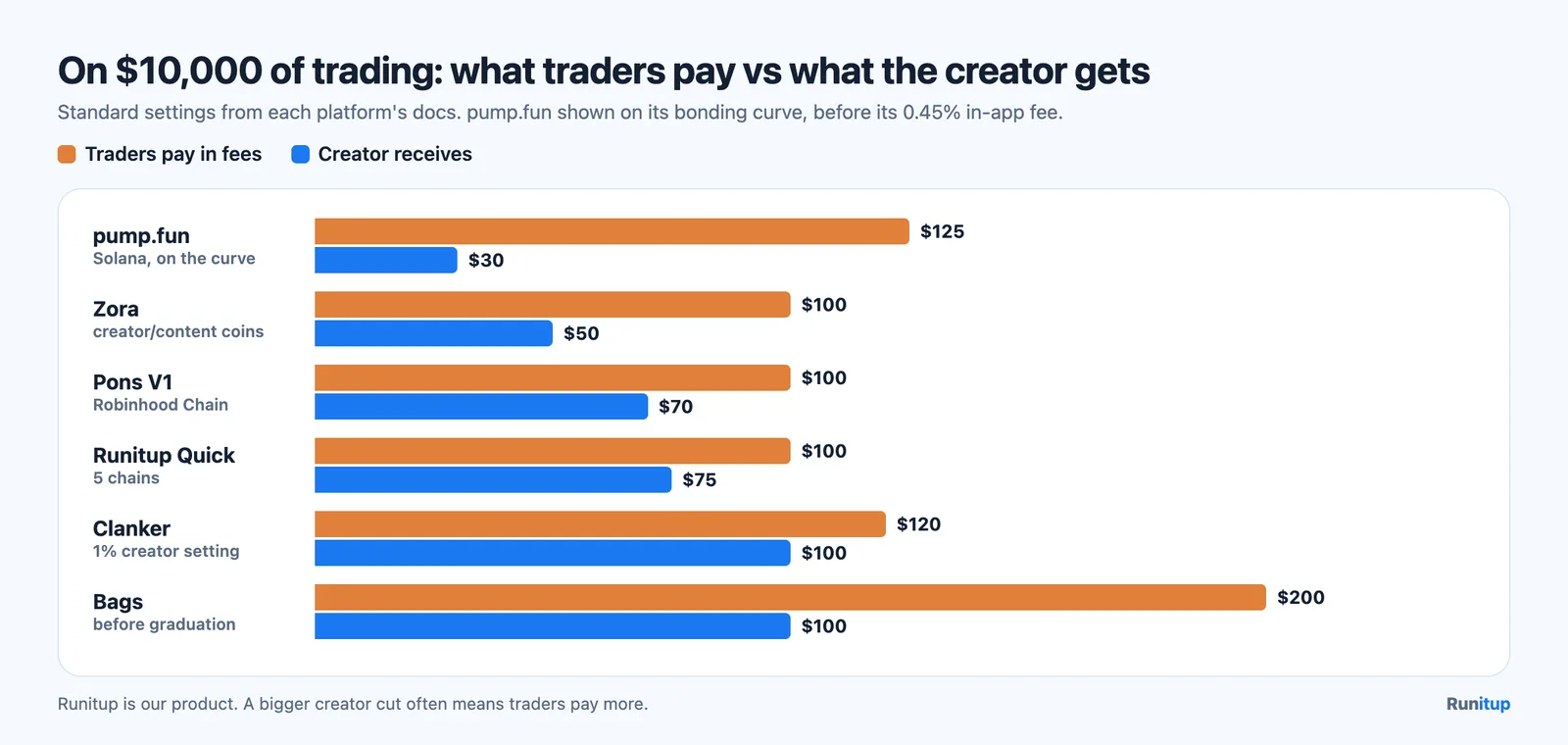
On $10,000 of trading:
- On Bags, traders pay $200 in fees and the creator gets $100.
- On Clanker at a 1% creator setting, traders pay $120 and the creator gets $100.
- On Runitup, traders pay $100 and the creator gets $75.
- On Pons V1, traders pay $100 and the creator gets $70.
- On Zora, traders pay $100 and the creator gets $50.
- On pump.fun's curve, traders pay $125 and the creator gets $30.
So the biggest creator fees in this table come from charging traders more. That's not wrong, and plenty of coins do well on Bags and Clanker. But traders notice fees. A 2% fee means a round trip (a buy and a sell) costs 4% before the price moves at all.
The fairer question is: what share of what traders pay reaches the creator? At the same 1% that traders pay, Runitup's 0.75% is the largest creator share among the 1% platforms in this table. Bags and Clanker pay the creator more per trade, and their traders pay more per trade too.
The same logic applies to taxes. On Runitup, an Advanced launch lets you add your own tax of 0% to 9% on top of a 1% standard fee. You earn more per trade, but every trader pays it, and some will skip taxed coins entirely. Four.meme's Tax Token works the same way.
Creator rewards: auto-sweep vs manual claim
Creator fees don't always land in your wallet by themselves. There are two models.
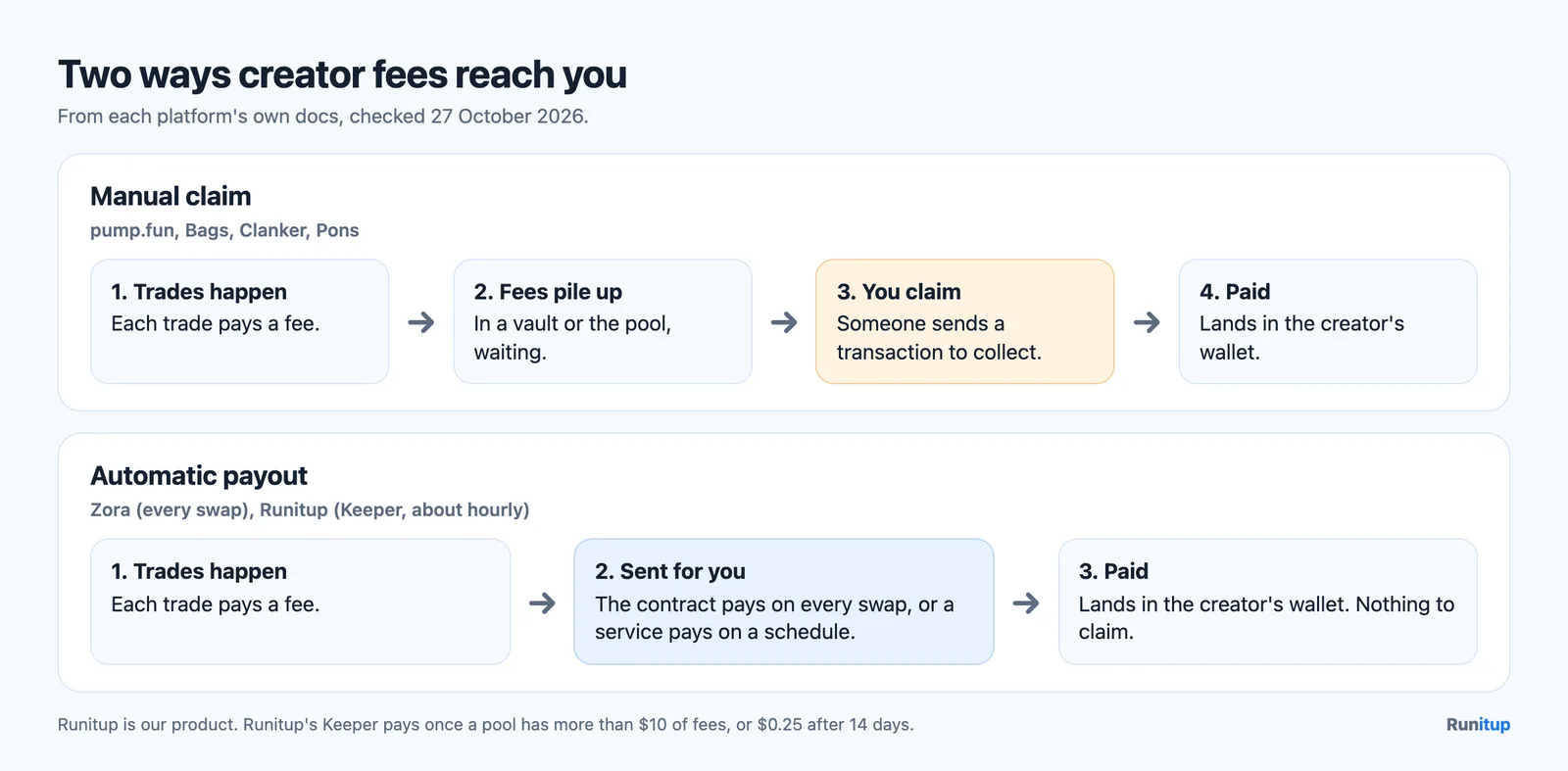
Manual claim. The fees pile up in a vault or pool, and you (or sometimes anyone) send a transaction to collect them. pump.fun, Bags, Clanker and Pons work this way. Pons explains why it chose this: if payouts were pushed automatically, "a single recipient whose wallet could not accept a transfer would be able to jam fee distribution for everyone else". That's a fair engineering point.
The downside is that you have to remember. Some systems also put a clock on it. Four.meme's OpenFour Royalty page, for example, says unclaimed revenue on one mode "may be handled according to the applicable rules after 60 days".
Automatic payout. The fees are sent to your wallet without you doing anything. Zora does it on every swap. Runitup runs a service called the Keeper that checks every Quick launch pool each hour and pays out once a pool has built up more than $10 of fees (or more than $0.25 that has sat for 14 days). There's nothing to claim and nothing expires.
Collection on Runitup is also permissionless, so if the Keeper ever stopped, you or anyone else could still trigger the payout from the contract. There's an optional button on My Launches to collect early, at any amount, if you'd rather not wait.
What you're paid in matters too
The last column of the table is easy to skip, but it changes what you actually end up holding.
- Paid in SOL, ETH, BNB or a stablecoin. Simple. You can spend it, and you never have to sell anything to realise it. pump.fun, Bags and Pons V2 pay in the pair asset.
- Paid partly in your own coin. On a plain pool fee, a buy pays its fee in the pair asset and a sell pays in your coin. So a creator ends up with some of both. Pons V1 and Runitup's v1 fee model work like this. To turn your coin into money, you have to sell it, and holders can see that on the chart.
- Paid in the platform's token. Zora converts rewards into ZORA, so your income moves with ZORA's price.
On Runitup's v2 fee model (a small contract on the pool, called a hook, charges the 1%), every fee arrives in the pair asset, never in your own coin. On BNB Chain that means BNB.
How do memecoin devs make money?
Creator fees are one route. Here are all four common ones, with the honest trade-offs.
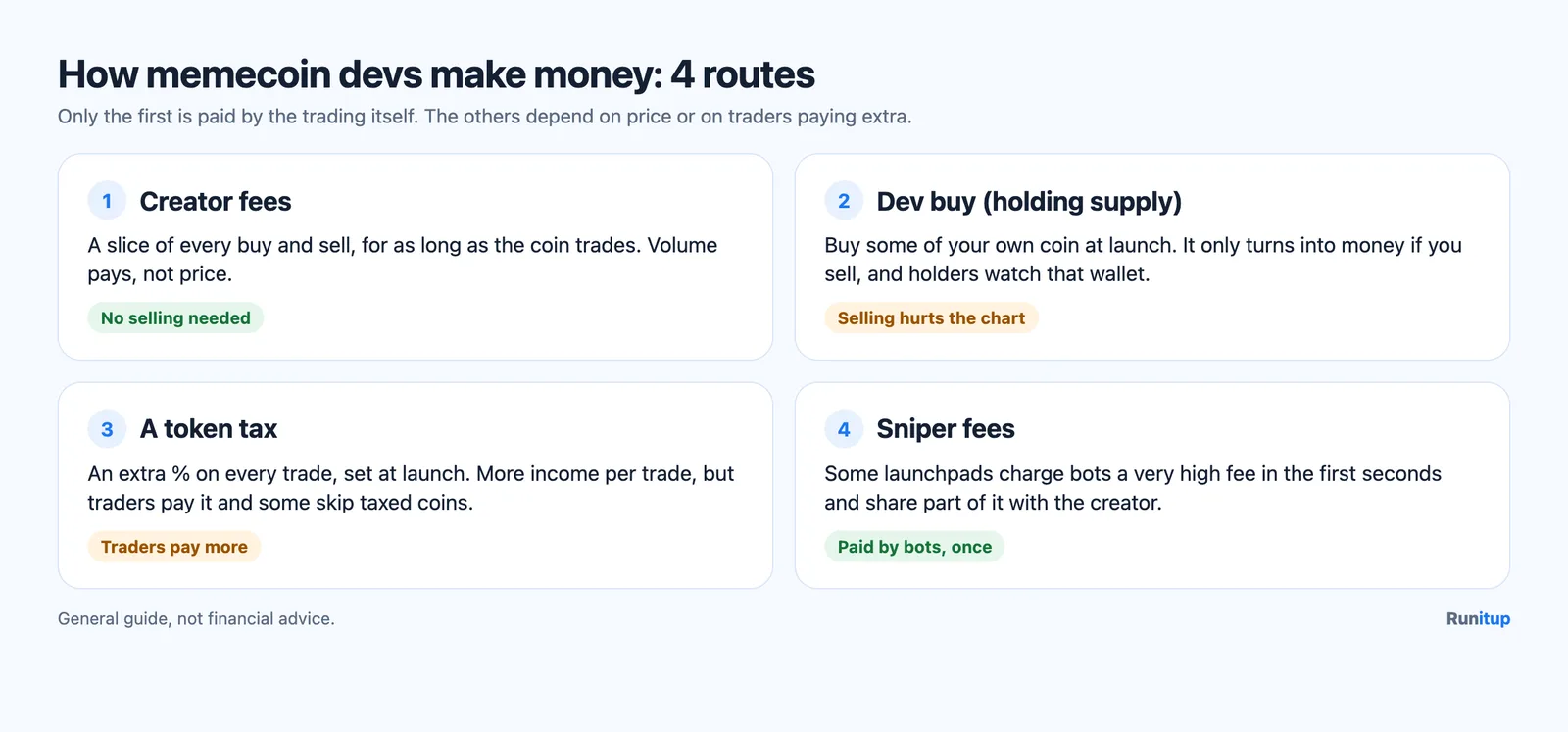
- Creator fees. A share of every trade, for as long as the coin trades. You don't need to sell anything, and it doesn't depend on the price going up. It does depend on volume, and most coins don't keep trading for long.
- A dev buy. You buy some of your own coin at launch. It only becomes money if the price rises and you sell. Holders watch the dev wallet closely, and a big sell can sink the chart and your reputation with it.
- A token tax. An extra percentage on every trade, set at launch. It pays more per trade than a creator fee, but traders pay it, and plenty of them filter out taxed coins.
- Sniper fees. Some launchpads charge bots a very high fee in the first seconds after launch. On Runitup's v2 model with a sniper window, bots buying in the first seconds pay up to 80%, and 75% of that goes to the creator. Zora charges 99% that falls to 1% over 10 seconds.
For context, Runitup's site shows $78.3K of creator earnings so far across 529 launches. That's the total, not a typical result. Most coins earn very little, and you should only launch with money you're happy to lose.
Choosing a memecoin launchpad for creator fees: 5 questions
If you're a dev picking where to launch, the headline creator fee is only one line. These five questions cover the rest:
- What do traders pay in total? A big creator cut on a big fee can cost you buyers. Compare the creator's share of the fee, not just the creator's percentage.
- Does the fee change over time? On pump.fun and Bags it changes at graduation, and on pump.fun again with market cap. A fixed rate is easier to plan around.
- Do I have to claim it? If yes, put a reminder somewhere. If it's automatic, check what the minimum payout is.
- What am I paid in? Getting paid in your own coin means selling it later to realise the money.
- Who controls the recipient? Check whether you can point the creator fees at a multisig or split them with a team, and what happens to them in a CTO.
A launchpad that answers all five clearly in its docs is usually a safer bet than one with a bigger number and fewer details.
How to check a coin's creator fee before you trade
If you're a trader, creator fees are part of what you pay. A quick check before you buy:
- Find out which launchpad made the coin. The coin page on that launchpad normally shows the fee.
- Look for a tax. On taxed coins, the tax is on top of the standard fee. Check both buy and sell rates.
- Check whether the fee changes after graduation. On pump.fun and Bags it does.
- Check who receives the fee. After a community takeover (CTO), the fee recipient can change on some launchpads.
Creator fees FAQ
Are creator fees paid by traders?
Yes. Creator fees come out of the trading fee that buyers and sellers pay. The creator doesn't pay them, they receive them.
Which launchpad has the highest creator fees?
Per trade, Bags (1% before graduation) and Clanker (1% at its docs' example setting) pay creators the most in this comparison, but their traders also pay more: 2% and 1.2%. Among launchpads that charge traders 1%, Runitup's 0.75% is the highest creator share we found.
Do I have to claim my creator fees?
It depends on the launchpad. pump.fun, Bags, Clanker and Pons use claims. Zora and Runitup pay automatically.
Can creator fees change after launch?
The split is usually fixed at launch. On Runitup and Pons V1 it's snapshotted when the coin launches and never changes. What can change is who receives it, for example after a community takeover.
What happens to creator fees in a community takeover?
On several launchpads, a CTO moves the creator fee to the new team. On Runitup, any fees not yet collected go to whoever the recipient is when they're collected, not who it was when they were earned.
How much do memecoin creators earn?
It's all about volume. At 0.75% of each trade, $100,000 of trading pays the creator $750. Most coins trade far less than that, and a few trade far more.
Want to see the numbers for yourself? Launch a coin in about a minute on any of our five chains, and your 0.75% starts with the very first trade.