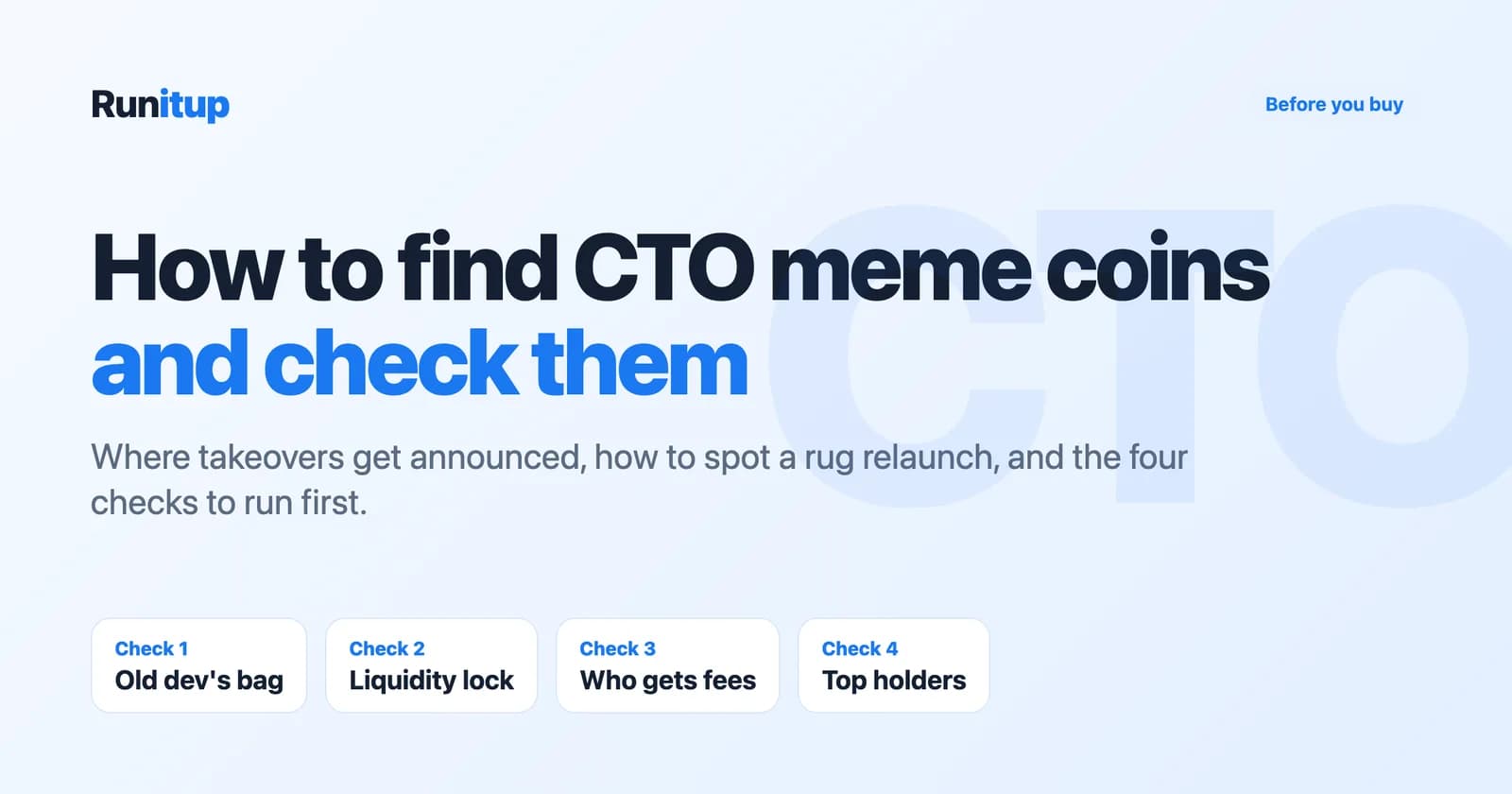
CTO meme coins are coins whose original dev walked away and whose holders took over the job of running them. Some CTO meme coins come back strongly, because a motivated community is worth more than a bored dev. Others are a dead coin with a new logo, or worse, a fresh rug wearing an old coin's name. This guide covers how to find CTO meme coins, how to tell a real takeover from a rug relaunch, and four on-chain checks to run before you buy.
Checking CTO meme coins needs no special tools. A block explorer, the coin's page on its launchpad and twenty minutes are enough. We use Runitup's token page in the examples because it is ours and it shows the right numbers in one place, but every check works on any chain with an explorer.
If you are on the other side, thinking about running a takeover yourself, read our companion guide on how to CTO a meme coin first.
What CTO meme coins are
CTO stands for community takeover. The dev who launched the coin stops posting, stops answering, and often sells. Holders who still want the coin to live set up new X and Telegram accounts, post a takeover announcement naming the contract address, and start doing the work: memes, raids, listings, answering newcomers.
What makes CTO meme coins interesting to traders is timing. A coin that was left for dead often trades far below its old highs. If a real team picks it up, the chart can recover. That is the whole appeal.
What makes them risky is that "CTO" is just a word in a bio. Anybody can type it. A takeover does not change the token contract, does not unlock or move the liquidity, and does not take tokens away from the old dev. So the coin you are buying still carries every risk it had before the takeover, plus the question of whether the new team is who they say they are.
Where to find CTO meme coins
CTO meme coins are announced in public, because a takeover nobody hears about is pointless. These are the places to look.
- X search. Search for the ticker with "CTO" ("$TICKER CTO") or just "CTO" with a chain name. Takeover teams post a pinned announcement from a new account with the full contract address. Sort by latest.
- The coin's old Telegram. When a dev disappears, the old group fills with "dev?" messages and, soon after, someone posting a link to the new community. If the group is still open, it is the most honest record of what happened.
- Screeners and trading bots. When a coin's socials suddenly change on a screener, that is often a takeover. Some screeners sell this as a paid product: DEX Screener's Enhanced Token Info, for example, lets a project put its logo and socials on its token page. A paid update is not proof the takeover is real. It just means somebody paid.
- The launchpad itself. Some launchpads have a process for takeovers. Runitup's is the community takeover page, where a team applies to have a coin's future creator fees redirected to them, and every request is read by a person. That is one more signal that a team has done the paperwork, not a guarantee.
- Live launch feeds. Old coins that start trading again after weeks of silence are worth a look. On Runitup, Pulse shows three lanes across every coin: the newest launches, the ones trading hardest today and the biggest by market cap. A forgotten coin reappearing in "trading hardest" is a reason to go and find out why.
Wherever you find CTO meme coins, the one thing you write down is the contract address. Names and tickers are not unique. On the day we wrote this, Pulse showed two different new coins with the same name and the same ticker, launched minutes apart. The address is the only thing that tells coins apart.
Real CTO meme coins vs rug relaunches
The most dangerous thing that calls itself a CTO is not a takeover at all. It is a rug relaunch: someone (sometimes the original dev) launches a brand new token with the same name and ticker, calls it the "CTO version" or "V2", and asks holders to move over. Then they rug the new one too.
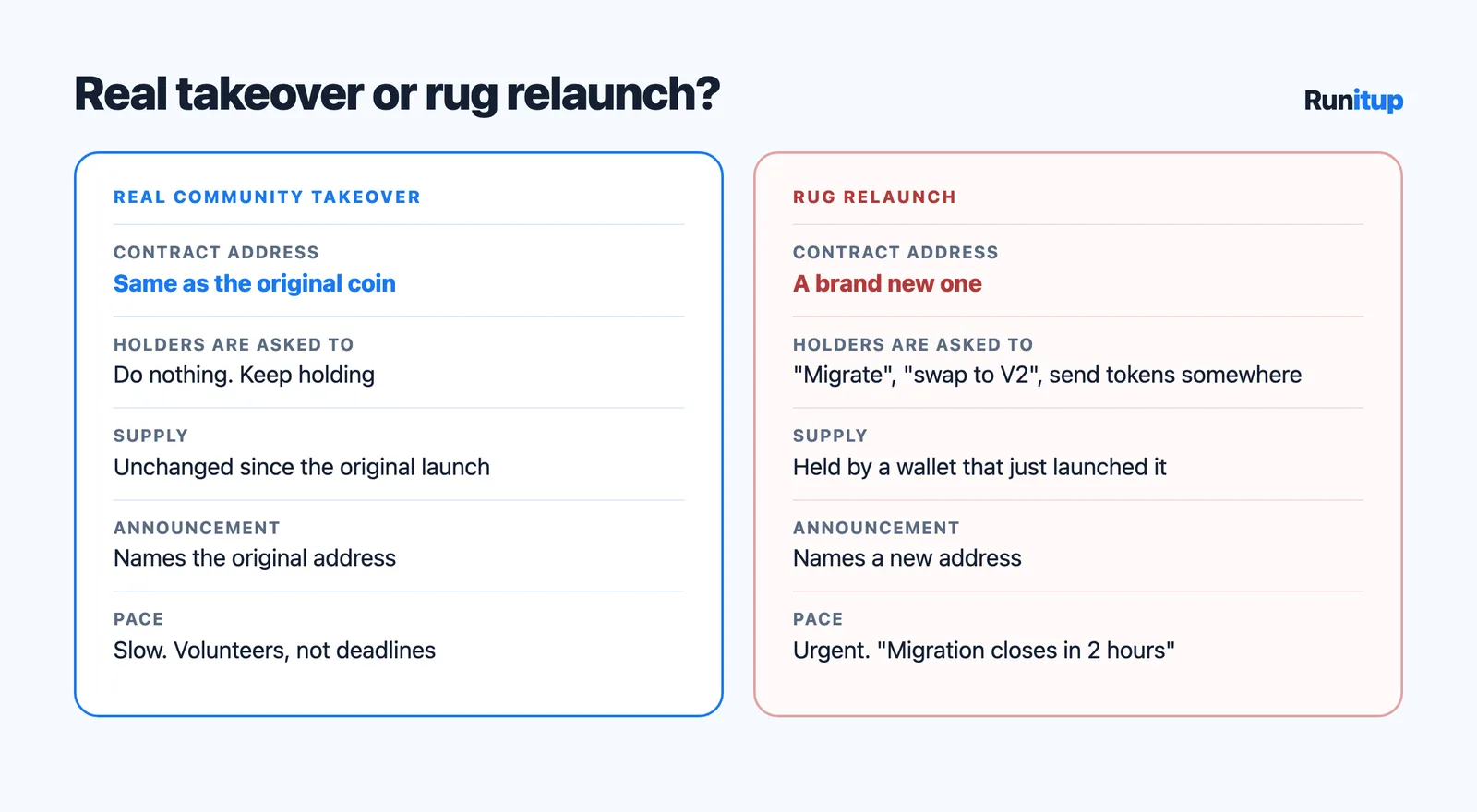
The test is simple. A real takeover keeps the same contract address. That is the whole point: the community is reviving the coin people already hold. A relaunch has a new contract address, and the new address is the tell.
| Sign | Real takeover | Rug relaunch |
|---|---|---|
| Contract address | Same as the original coin | A new one |
| What holders are asked to do | Nothing. Keep holding | "Migrate", "swap to V2", send tokens somewhere |
| Who controls the supply | Unchanged from the original launch | A wallet that just launched it |
| Old holders | Still holders | Left on the old coin |
| Announcement | Names the original address | Names a new address |
A few more signs of a relaunch:
- "Send your tokens here for the new coin." Nobody running a real takeover needs your tokens. Any request to send tokens to a wallet or contract for a "migration" should end the conversation.
- A fresh deployer wallet. On an explorer, look at who created the new contract. A wallet created yesterday and funded from an exchange tells you very little. A wallet with a history of launching coins that died within days tells you a lot.
- Urgency. "Migration closes in 2 hours" is a pressure tactic. Real takeovers move slowly because they are run by volunteers.
4 on-chain checks for CTO meme coins
Once you have found one of these CTO meme coins and you are sure the address is the original coin, run these four checks. Each one answers a question the takeover announcement cannot.
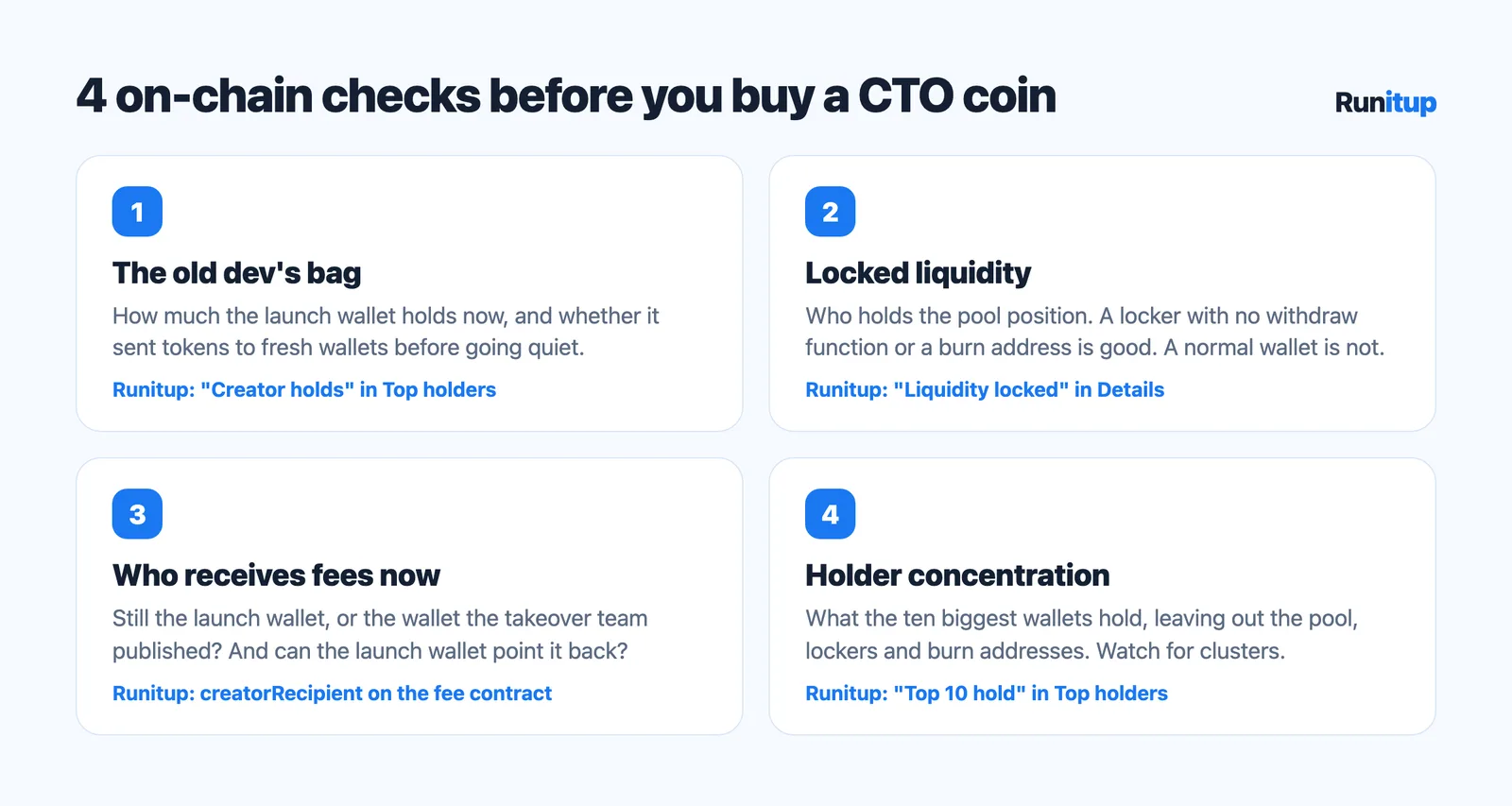
1. How big is the old dev's bag?
On most CTO meme coins the old dev still holds tokens, and a takeover does nothing to them. Every token in that wallet is supply that can be sold on the community at any moment.
How to check:
- Find the wallet that launched the coin. On Runitup the token page header shows it as Deployed by.
- Look at what it holds now. On Runitup, the Top holders tab shows Creator holds, which is the launching wallet's current balance, not a launch-day figure. On any other coin, open the deployer wallet on the explorer and look at its balance of the token.
- Check where tokens went. If the dev wallet sent large amounts to fresh wallets shortly before going quiet, the "dev bag" may be split across several wallets that look like ordinary holders.
Among CTO meme coins, a dev who sold everything and left is actually the cleaner case. A dev who went quiet while holding a big bag is the one to worry about.
2. Does it have locked liquidity?
Liquidity is the money in the coin's pool that lets people sell. If someone can withdraw it, they can empty the pool and leave everyone holding a coin nobody can sell. On CTO meme coins the takeover does not change who can touch the liquidity, so check it as if the takeover had not happened. Locked liquidity is the baseline, not a bonus.
How to check:
- On Runitup, every launch's liquidity is locked at launch: the factory mints the pool position straight into a locker contract that has no function to withdraw it. The token page's Details tab shows Liquidity locked, and the liquidity lock docs show how to confirm it yourself with a single read on the locker.
- On other launchpads and plain DEX pools, find out who holds the pool position. If it sits in a known locker or was sent to a burn address, the liquidity cannot be pulled. If it sits in a normal wallet, it can.
- Check the lock has no end date. A lock that expires next week is a countdown, not a lock.
3. Who receives the fees now?
On launchpads that pay creators a share of trading fees, the fees keep flowing after the dev leaves. Whether the fees on CTO meme coins now go to the takeover team, the old dev or nobody tells you a lot about the takeover.
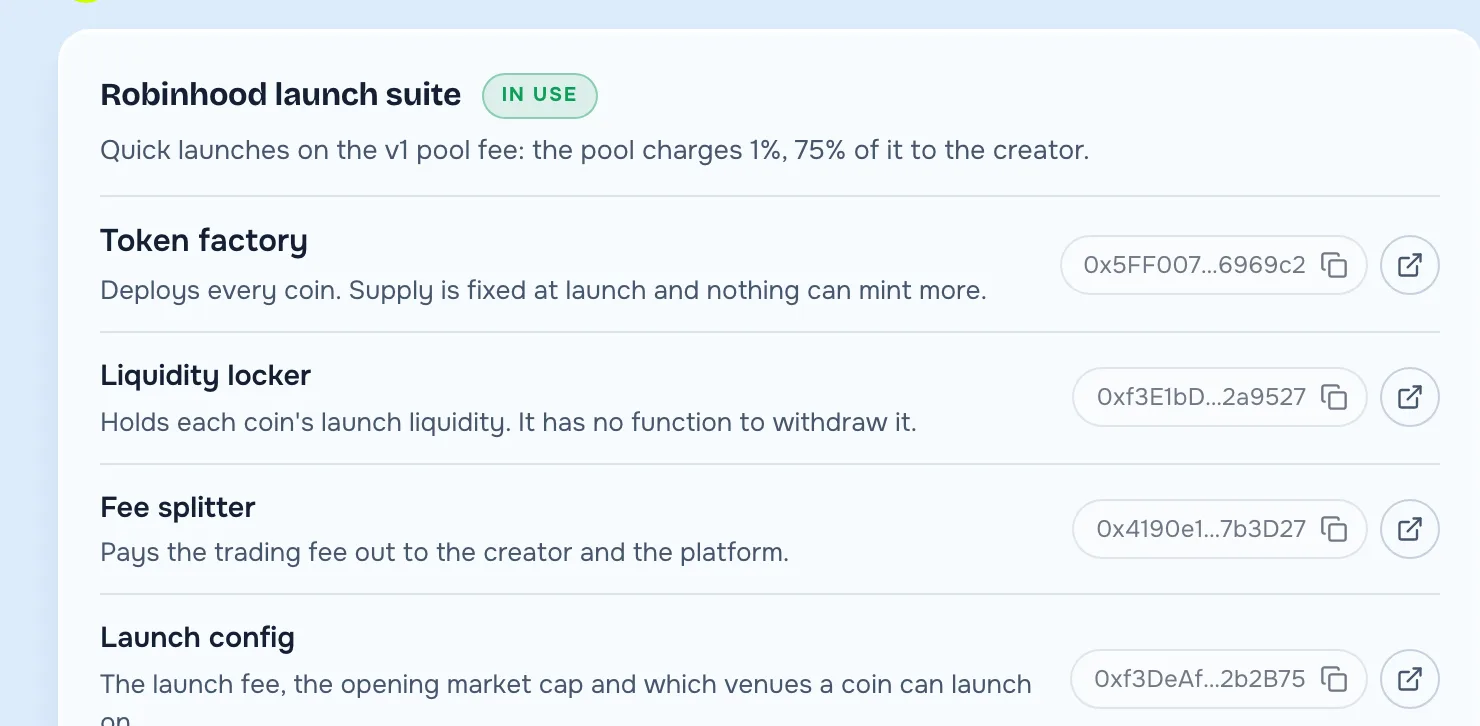
On Runitup, a coin's creator share (75% of the 1% pool fee on a Quick launch) is paid to a recipient address recorded in the suite's fee contract. You can find that contract for each suite on the contracts page. Open it on the chain's explorer (Runitup's Base fee contract, for example, is verified on Basescan, so it has a Read Contract tab). There, creatorRecipient with the coin's address gives the current recipient, and creatorOf gives the wallet that launched it.
What the answers mean:
- Recipient is still the launch wallet. No fee redirect has happened, or it was reversed. The takeover team is working for free, which is admirable but worth knowing.
- Recipient is a new wallet, and it matches what the takeover team published. The fees have been redirected to them.
- On most Runitup coins, the launch wallet can point the fees back. On the suites behind almost every live Runitup coin, the creator record is set once at launch and cannot be changed, and that wallet keeps the right to change the recipient. It has already happened on one Runitup coin: in October 2026 the launch wallet repointed the fees back to itself minutes after a takeover redirect. So a fee redirect is a good sign, not a settled fact.
On other launchpads, read that launchpad's own docs on creator fees. Many have no takeover process, which means the fees keep going to the departed dev.
4. Holder concentration: who holds the supply?
A coin where ten wallets hold most of the supply can be dumped by ten people. On CTO meme coins it is often worse, not better, because a takeover team often buys a large bag and the old dev may still hold one.
Holder concentration is the easiest of the four to check.
- On Runitup, the Top holders tab shows Top 10 hold, the share the ten largest wallets hold between them. The pool's own balance and burn addresses are left out, because the pool starts by holding the whole supply and counting it would make the figure meaningless.
- On any explorer, open the token's holders list and add up the top ten yourself. Leave out the pool, the locker and burn addresses.
- Look for clusters: several wallets of similar size, created around the same time, funded from the same source. That is often one person.
There is no magic number. As a rough rule, the more of the supply sits in a handful of wallets that are not the pool, the more any one of them can move the price.
Worked example: checking CTO meme coins step by step
Here is how the four checks fit together. The numbers below are made up to show the method, not taken from a real coin.
You find a pinned post from a new X account: "$EXAMPLE is now a CTO", with a contract address. The old Telegram confirms the dev has not posted for five weeks.
- Same address? The address in the post matches the coin's original contract. Not a relaunch.
- Dev bag: Creator holds shows 0.4% of supply, and the explorer shows the dev sold over a month ago. The dev has left.
- Liquidity: Details shows the liquidity locked, and a read on the locker confirms the position is held there.
- Fees:
creatorRecipientreturns a wallet the CTO team named in its announcement. On this suite the launch wallet could point it back, so the team's plans should not depend on those fees. - Holders: Top 10 hold is 21%, and the largest wallet is the CTO team's public wallet with 6%.
That coin passes. Like all CTO meme coins it might still go to zero, because most coins do, but nothing in it is hiding a trap. Change any one answer, a new contract address or a dev still holding 30%, and the picture changes completely.
Red flags on CTO meme coins
Any one of these is a reason to pass, however good the community looks.
- A new contract address presented as "the CTO".
- Any request to send tokens somewhere for a migration.
- The old dev still holding a large share, with no explanation.
- Liquidity that can be withdrawn, or a lock with an expiry date.
- A takeover team that will not say which wallet receives fees, or names a wallet that does not match the chain.
- Top holders that look like one person split into ten wallets.
- An announcement that never states the full contract address.
CTO meme coins FAQ
Are CTO meme coins safer than new launches?
Not automatically. The original launch's risks are still there, plus a new team you have to trust. A coin with a locked pool, a dev who sold out and a spread-out holder list is safer than one without, CTO or not.
Do CTO meme coins give the new team control of the coin?
No. Nobody gets new control over the token contract or the liquidity. On Runitup, a takeover redirects the coin's future creator fees, and on most Runitup coins the original launch wallet can still point those fees back.
How do I know a community takeover was approved by the launchpad?
Read the fee recipient on chain. If the launchpad redirected the fees, the recipient will be the wallet the takeover team published. On Runitup that is creatorRecipient on the fee contract listed on the contracts page.
Can I find CTO meme coins on Runitup?
Any coin launched on Runitup can go through a takeover, and you can run all four checks from its token page plus an explorer. Runitup does not publish a list of approved takeovers, so the on-chain fee recipient is the thing to check.
What should I do if a CTO coin asks me to migrate?
Do not send anything. A real takeover keeps the same contract, so there is nothing to migrate. Treat any migration request as a scam until proven otherwise.
Tracking CTO meme coins after you buy
The checks above are a snapshot. CTO meme coins change faster than most coins, because the situation that created them is still settling. Three things are worth re-checking every few days while you hold.
- The fee recipient. On Runitup, the fee contract emits an event every time a coin's recipient changes, and anyone can read the current one. If the takeover team's wallet stops being the recipient, the old dev may be back, and the team's plans may change.
- The old dev's wallet. Watch the deployer wallet on the explorer. A dev wallet that suddenly starts moving tokens again after weeks of silence is the clearest early warning you will get.
- The holder list. Holder concentration drifts. If the top ten wallets are steadily growing their share while the holder count falls, a few people are accumulating and everyone else is leaving.
And keep an eye on the team itself. Takeovers run on volunteer energy. When the daily posts thin out, the coin is heading back to where it was before the takeover.
Running a takeover instead
If you are reading this because you hold a coin whose dev just vanished, you may be the takeover team rather than a buyer of CTO meme coins. Our guide on how to CTO a meme coin walks through the whole playbook, including the Runitup takeover form and exactly what a fee redirect can and cannot do.